
 Tax season surfaces questions that commission advance providers hear regularly: does a commission advance count as taxable income? How does it show up on a 1099? Is the fee deductible? The answers are straightforward, but the mechanics of how they work in practice are worth understanding clearly, particularly for agents who advance commissions multiple times a year or whose advances cross tax year boundaries.
This page discusses general tax considerations related to commission advances for informational purposes only and does not constitute tax advice. Agents should consult a licensed CPA or tax advisor for guidance specific to their situation.
Key Takeaways
- A commission advance is a purchase of a future earned receivable.
- The broker issues the 1099 for the agent’s full commission at year-end, including any portion that was advanced. The advance fee is not netted out on the 1099.
- The advance company does not issue a separate 1099 to the agent.
- The advance fee is generally deductible as an ordinary business expense, which offsets the gross commission reported on the 1099.
- When an advance and its closing fall in different tax years, the income and the related fee deduction may land in separate filings. This is worth discussing with a CPA before year-end.
- Accurate record-keeping for each advance is what substantiates the deduction.
Is a Commission Advance Taxable Income?
A commission advance is structured as a purchase of a portion of a future earned commission.
It’s neither a loan, nor a separate income event. The advance company pays the agent a discounted amount upfront in exchange for the right to collect the full advanced portion at closing.
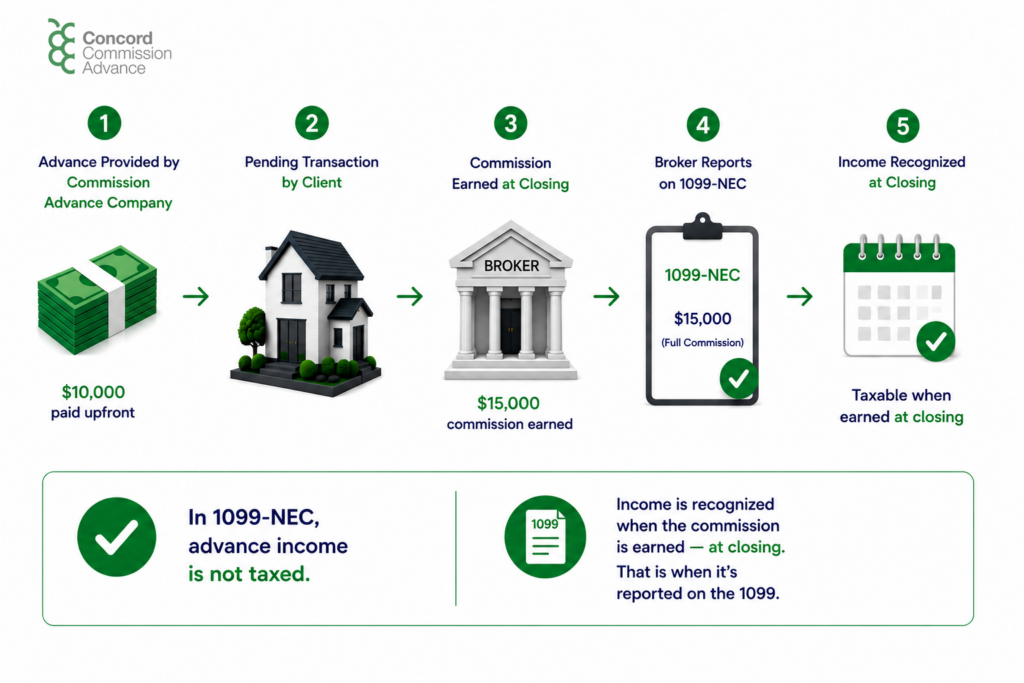
Because the agent is not receiving new income, only early access to income already tied to a pending transaction, the advance itself does not create a taxable event at the time it is received.
Income is recognized when the commission is earned, which occurs at closing. That is when the broker reports it on the 1099.
How the 1099 Works
Real estate agents operating as independent contractors receive a 1099-NEC from their broker at year-end, reporting gross commission income for all transactions closed during the year.
The 1099 reflects the full commission on each closed transaction, including any portion that was advanced earlier. The advance fee is not netted out by the broker before the figure is reported. The advance company is not a party to that reporting and does not issue a separate 1099 to the agent.
Example: An agent receives a $10,000 advance on a $15,000 commission at a 5% fee. The agent receives $9,500 upfront. At closing, the advance company receives $10,000 from the commission disbursement and the agent receives the remaining $5,000. The broker’s 1099 reports $15,000 (i.e. the full commission). The $500 fee is deducted separately as a business expense on Schedule C.
The Advance Fee as a Business Expense
The fee charged by the advance company is generally deductible as an ordinary and necessary business expense under IRS rules for self-employed individuals. This is the mechanism that restores the economic balance: the gross commission is reported in full on the 1099, and the fee paid to access it early is deducted on Schedule C.
This deductibility also applies when the advance is used to cover quarterly estimated tax payments, an expense real estate agents, as independent contractors, are required to make multiple times a year. The fee paid on that advance remains deductible regardless of what the advance funds are used for.
A licensed CPA should confirm the correct expense category and treatment specific to each agent’s situation.
When the Advance and the Closing Fall in Different Tax Years
An advance received in November or December on a transaction closing in January or February creates a timing question.
Because the advance is a purchase of a future receivable rather than a loan, the income is recognized at closing, when the commission is earned and reported on the 1099. The fee deduction follows the same logic: it is tied to the transaction, and not to the date the advance was received.
An agent who receives an advance in December and closes in January would:
- Report no additional income in the year the advance was received
- Report the full commission on the following year’s 1099
- Deduct the advance fee in the tax year the commission is earned
Agents with multiple advances straddling a calendar year-end should discuss the timing with a CPA before filing.
If a Deal Falls Through
When a transaction does not close, the commission is never earned and the broker issues no 1099 for that transaction. The advance is recovered from a future commission, which will appear on a future 1099 when that transaction closes.
Whether the advance fee for the fallen deal is deductible in the year it was charged, or in the year the matter resolves through a future closing, depends on the agent’s accounting method and specific circumstances.
What Records to Keep
Clean documentation is what makes a deduction defensible. For each advance, agents should retain:
- The signed advance agreement, showing the advance amount, fee, and estimated closing date
- Confirmation of the fee charged at the time of funding
- The closing statement showing the full commission and the disbursement to the advance company
- The year-end 1099 from the broker
These documents connect the gross commission reported on the 1099 to the business expense being deducted, which is what substantiates the claim if questioned.
Common Questions
Does the advance company report anything to the IRS?
No. The advance company purchased a receivable, it did not pay income to the agent. It has no 1099 reporting obligation to the agent.
What if the broker nets out the advance fee before issuing the 1099?
This varies by brokerage. Agents should confirm with their broker how commission disbursements are reported at year-end, particularly when an advance is involved, and ensure the figure on the 1099 matches the closing statement.
Does using commission advances frequently create any IRS reporting flags?
No. Commission advance usage does not alter independent contractor status or create any special reporting obligation. It is a business financing transaction, not a structural change in how income is classified.
Is the full commission taxable even though an advance fee was deducted?
Yes. The 1099 reflects the full commission earned: the advance fee does not reduce that figure. The fee is claimed separately as a business expense on Schedule C, which is what brings the taxable income in line with what the agent actually kept.
The Bottom Line
A commission advance does not create a separate taxable event. The broker reports the full commission at year-end, and the advance fee is generally deductible as a business expense, making the net tax impact equivalent to what it would have been without the advance. Where the picture gets more complex is when advances and closings cross tax years, when deals fall through, or when the timing of estimated tax payments is involved.
Concord Advance provides commission advances to real estate agents and brokers nationwide. Full pricing is disclosed before any agreement is signed. Applications are completed online at concordadvance.com.

