
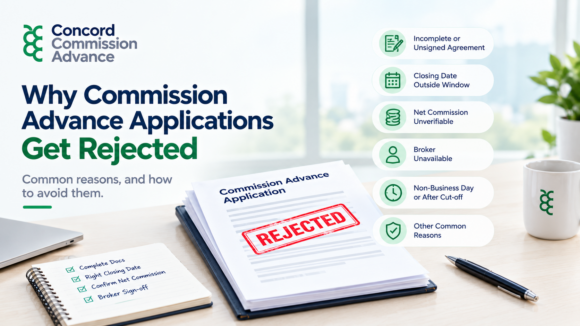
The Most Common Reasons a Commission Advance Application Gets Rejected and How to Avoid Them
Most commission advance applications are approved. The ones that are not typically fail for a small set of predictable, avoidable reasons. Understanding them before submitting an application saves time and, in time-sensitive situations, the deal itself. Key Takeaways The most common reasons for rejection are incomplete or unsigned purchase agreements, closing dates outside the provider’s […]
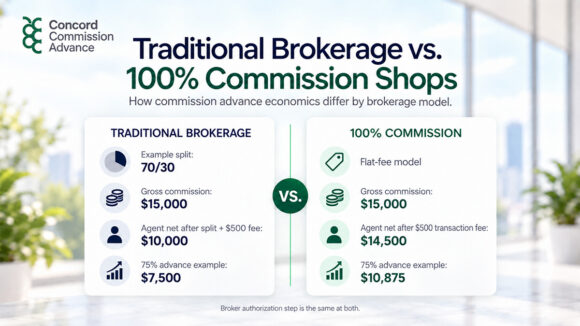
Commission Advance for Realtors at Traditional Brokerages vs. 100% Commission Shops: How the Economics Differ
The decision to take a commission advance plays out differently depending on where a Realtor hangs their license. The mechanics of the advance itself are the same. What differs is the economic context: how the commission is split, what fees apply on top of that split, how large the agent’s net commission actually is, and […]
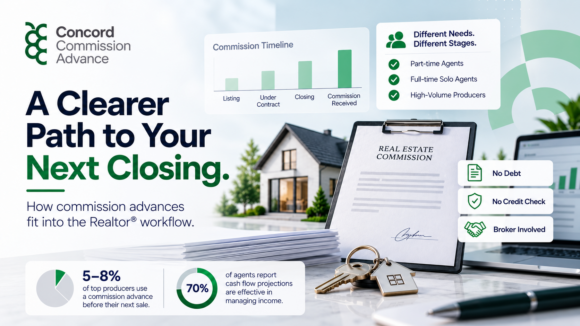
Commission Advance for Realtors: The Complete 2026 Guide
A Realtor refers specifically to agents and brokers who are dues-paying members of the National Association of Realtors, bound by the NAR Code of Ethics, and operating under MLS rules and governance. That distinction shapes the specific brokerage structures, compensation agreements, and transaction mechanics through which a Realtor earns and receives commission income. This page […]
Real Estate Commission Advance: California Agent Guide
California is the largest real estate market in the United States by transaction volume and commission value. It is also one of the most operationally complex, with escrow-based closings, attorney review requirements in certain transactions, and one of the highest average days-on-market figures of any major state. For California agents, the gap between a signed […]
How Commission Advance Underwriting Works: What Gets Approved and Why
Every commission advance application goes through a review process before funds are released. Unlike traditional loan underwriting which evaluates the borrower’s financial history, credit score, and income, commission advance underwriting is based entirely on the strength of the pending transaction. Understanding what advance companies look at, and why certain applications move faster than others, helps […]
Concord Advance vs. Tongo: Which Commission Advance Is Right for You?
Concord Advance and Tongo both give real estate agents early access to pending commissions. Beyond that shared purpose, they are structurally different products, built on different models, with different fee structures, different broker requirements, and different target use cases. This comparison covers what each product actually is, how the costs compare, and which type of […]
Do You Need Your Broker’s Signature for a Commission Advance?
In most cases, yes. A broker’s signature is a standard requirement for a commission advance and the reason is legal, not procedural. This page explains why the broker’s involvement is necessary, what they are actually signing, and how to handle situations where the broker has not encountered the process before. Key Takeaways In most states, […]

