
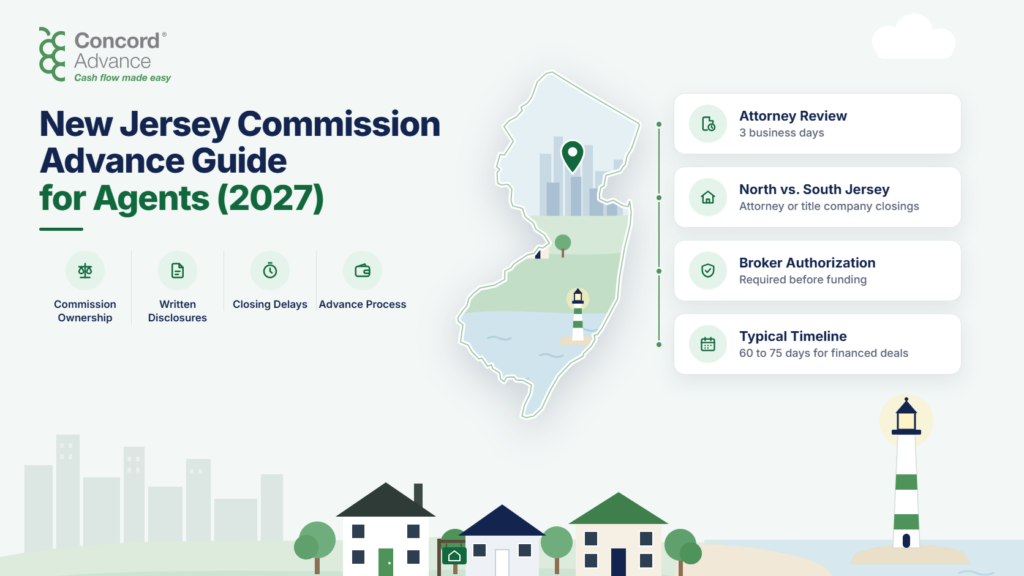
New Jersey has a closing process unlike any other state. The process includes a mandatory attorney review period, a hybrid closing model that operates differently in the northern and southern halves of the state, and a transaction timeline that routinely runs 60 to 75 days for financed deals.
For agents navigating that timeline, the gap between a signed contract and a received commission is structured differently here than in most markets.
This guide covers how commission advances work within New Jersey’s specific legal and procedural framework.
Key Takeaways
- New Jersey is the only state with a mandatory 3-business-day attorney review period built into every standard residential contract.
- North Jersey transactions are attorney-driven; South Jersey transactions are typically handled by title companies.
- The New Jersey Real Estate Consumer Protection Act, signed in 2025, requires all compensation arrangements to be disclosed in writing before brokerage services begin.
- Commissions in New Jersey are legally owned by the broker. Broker authorization is required before an advance is funded.
- New Jersey’s Realty Transfer Fee, municipal inspection requirements, and attorney coordination timelines are among the most common sources of closing delays in the state.
The New Jersey Closing Timeline and What It Means for Agents
A financed residential transaction in New Jersey typically runs 60 to 75 days from executed contract to closing. Several structural features of the state’s closing process drive that timeline.
The 3-day attorney review period. Every standard New Jersey residential contract (NJAR Form 118) contains a mandatory 3-business-day attorney review clause. During those three days, either party’s attorney may disapprove the contract, propose modifications, or cancel entirely without penalty. Until attorney review concludes without cancellation, the transaction is not firm.
Most commission advance companies treat the contract as eligible for an advance only after the attorney review period has passed without cancellation. This is a standard practice and worth understanding before submitting an application immediately after contract signing.
Municipal inspection and Certificate of Occupancy requirements. New Jersey municipalities require a Certificate of Occupancy or Certificate of Continued Occupancy before a residential closing can proceed. The municipal inspection that produces this certificate must be scheduled, conducted, and cleared before closing. During peak selling season, inspection backlogs at some municipalities can delay the certificate by two to three weeks. Certificates carry a 90-day validity window,. If the closing is delayed past that window, a new inspection may be required.
North vs. South Jersey closing models. North Jersey transactions, roughly the New York metropolitan area, are attorney-driven. Attorneys hold earnest money, conduct contract review, coordinate title, and typically manage the closing. South Jersey transactions more commonly use title companies in the settlement agent role, consistent with how most other states operate.
Both models are eligible for commission advances. The disbursement mechanics differ: in attorney-driven closings, the closing attorney disburses per the broker’s authorization; in title company closings, the title company handles disbursement. Agents should confirm which model applies to their transaction when applying.
How Commission Ownership Works in New Jersey
Under New Jersey’s real estate license statutes (N.J.A.C. 11:5), commissions are paid to the licensed broker, not the individual salesperson or broker-salesperson. The New Jersey Real Estate License Act also specifies that commissions shall be paid at the time of closing, which means an agent cannot receive payment before a closing has occurred and title has transferred.
The commission advance structure does not conflict with this requirement. The advance is a purchase of the agent’s future earned commission, a transaction between the agent and the advance company, and the repayment occurs at closing through the broker’s authorized disbursement. The agent receives the advance before closing; the advance company receives its portion at closing from the commission disbursement.
The broker’s written authorization is what makes this work within New Jersey’s legal framework. The authorization directs the closing attorney or title company to disburse a specified amount to the advance company at closing, consistent with the broker’s authority to direct commission disbursements.
The New Jersey Real Estate Consumer Protection Act (2025)
Signed into law in 2025, the New Jersey Real Estate Consumer Protection Act added a state-level requirement on top of the NAR settlement’s national framework. All compensation arrangements between agents and clients must be disclosed in writing before brokerage services begin.
For listing agents, this means the commission structure, including any buyer agent compensation the seller agrees to offer, is documented in the listing agreement before the property goes to market. For buyer’s agents, the written buyer representation agreement must specify compensation terms before the first showing.
This documentation layer is directly relevant to commission advance applications. The advance company needs to confirm the agent’s net commission from the transaction. In New Jersey, that commission structure is now documented in a written agreement at the start of the relationship. Agents who provide this documentation with their advance application reduce the verification time on their application.
What NJ-Specific Factors Extend Closing Timelines
Realty Transfer Fee (RTF) disputes. New Jersey’s RTF is a seller-paid tax calculated on the sale price, with a tiered rate structure and an additional Graduated Percent Fee on transactions above $1 million. RTF calculations are sometimes disputed between parties or require correction before the settlement statement is finalized, creating a last-minute closing delay.
Environmental and flood zone documentation. New Jersey has significant coastal and riverine floodplain exposure. Transactions involving properties in FEMA flood zones require flood insurance to be bound before closing. For properties with complex flood zone histories, this can take longer than anticipated.
Well and septic inspections. Properties in rural and suburban New Jersey served by private wells and septic systems require passing well and septic inspections before closing. Septic inspections in particular can reveal system failures requiring repair or replacement before the closing can proceed, adding weeks to a transaction that appeared straightforward at contract.
Title complications in older housing stock. New Jersey has a significant inventory of older residential properties, particularly in Essex, Hudson, Bergen, and Union counties. Older properties carry higher rates of title complications like unresolved liens, estate ownership, or easement disputes, that require legal resolution before clear title can be issued.
Each of these factors is a potential source of closing delay beyond the initial estimate. Concord Advance’s 15-day grace period covers the most common short-term delays at no additional charge.
What New Jersey Agents Use Commission Advances For
- Operating through the 60 to 75-day closing timeline: carrying monthly business and personal expenses while a standard financed transaction runs its full course
- Covering attorney coordination costs: North Jersey agents routinely coordinate with both their client’s attorney and the opposing attorney through the closing process, an administrative layer absent in most other states
- Funding listing marketing upfront: New Jersey’s competitive suburban markets, particularly in Bergen, Morris, Essex, and Monmouth counties, require professional photography, staging, and digital advertising paid before the listing goes under contract
- Bridging municipal inspection delays: when a Certificate of Occupancy backlog pushes a closing two to three weeks past the expected date, an advance on a different pending transaction maintains cash flow through the extension
- Managing the attorney review period uncertainty: agents who have invested time and marketing spend in a listing and then face a contract cancellation during attorney review may need liquidity while the property returns to market
How a Commission Advance Works in New Jersey
The process follows the standard commission advance structure, with the attorney review period as the primary New Jersey-specific consideration.
- The agent submits an online application with the transaction details, including property address, expected closing date, and confirmed net commission amount.
- The advance company reviews the executed purchase agreement. Applications on New Jersey transactions are typically processed after the attorney review period has concluded without cancellation.
- The broker provides written authorization directing the advance repayment at closing, to the closing attorney for North Jersey, or to the title company for South Jersey.
- Funds are deposited into the agent’s bank account, typically within 24 hours of approval.
- At closing, the closing attorney or title company disburses the commission per the broker’s authorization. One portion is directed to the advance company; the remainder goes to the agent through the broker.
Common Questions
Does the attorney review period affect when an agent can apply?
Most advance companies process applications after the attorney review period concludes without cancellation, since the transaction is not firm until that window passes. Agents should confirm timing with their provider, but submitting immediately after attorney review is the standard approach in New Jersey.
Does the RTF affect the commission disbursement?
The RTF is a seller-paid tax deducted from the seller’s proceeds, not from the commission. It does not directly affect the commission disbursement. However, RTF disputes that delay the final settlement statement can delay the closing, which affects when the commission arrives.
Can both the listing agent and buyer’s agent advance on the same New Jersey transaction?
Yes. Each agent’s commission is separate. Both can apply independently, provided each has a confirmed net commission and their respective broker’s authorization.
Does the advance affect the agent’s independent contractor status under New Jersey law?
No. New Jersey formally codified independent contractor status for real estate agents through the Real Estate Commission in 2024. A commission advance is a financial arrangement between the agent and the advance company. It has no bearing on how the agent’s working relationship with the broker is classified.
The Bottom Line
New Jersey’s closing process is among the most procedurally detailed in the country. The attorney review period, the hybrid closing model, municipal inspection requirements, and a 60 to 75-day financed closing timeline create a consistent gap between a signed contract and a received commission.
A commission advance provides access to earned income while that process runs its course.
Concord Advance provides commission advances to New Jersey real estate agents statewide and nationwide. Applications are completed online at concordadvance.com/apply, and full pricing is published at concordadvance.com/rates-page.

