
March 22, 2026
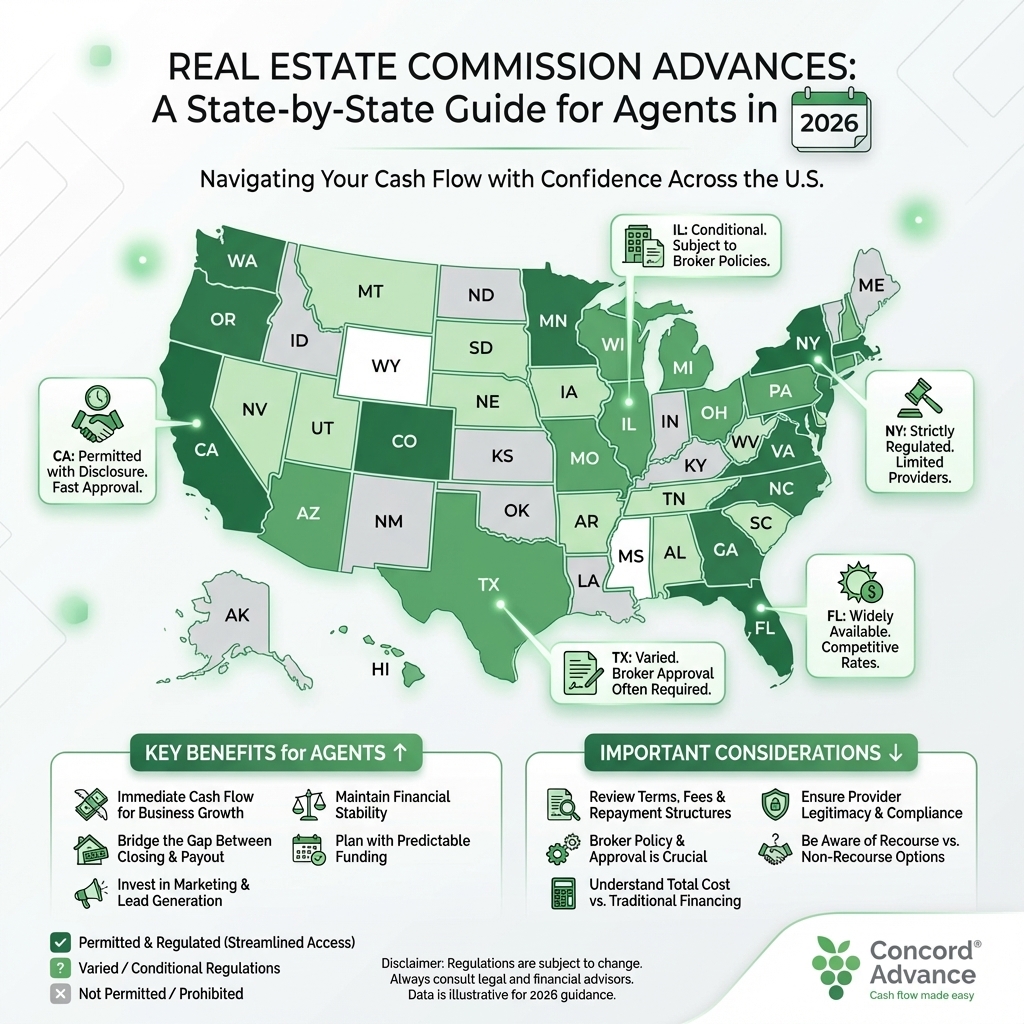
Real Estate Commission Advances: A State-by-State Guide for Agents in 2026
Navigating the ebbs and flows of the real estate market can be financially challenging for agents. Commission payouts can take weeks or even months to process after a deal closes, placing strain on even the most seasoned professionals. This has led to the growing popularity of real estate commission advances: financial tools designed to bridge the gap between closing a sale and receiving your earned commission. If you’re considering this cash flow solution, understanding the nuances of commission advances by state is crucial. Each locale features distinct regulatory frameworks, broker approval processes, and timing expectations.
In this comprehensive guide, we’ll break down what real estate commission advances are, highlight general requirements, and drill into how the process plays out across top real estate states: Texas, California, Florida, New York, Colorado, and Arizona. Whether you’re searching for a real estate advance Texas option, a California commission advance breakdown, or Florida realtor advance insights, you’ll find state-specific guidance and answers here.
What Are Real Estate Commission Advances?
A real estate commission advance allows agents to receive a portion of their pending commission before the official payout from their broker. Upon the successful completion of a home sale and the signing of a sales contract, an agent can partner with a commission advance company. This third-party essentially “buys” part of the agent’s future commission in exchange for a small fee, providing the agent immediate cash to cover expenses, reinvest in marketing, or smooth out gaps between closings.
The advancement is not a loan. There are no monthly interest charges or lengthy qualification checks. Rather, the advance is repaid directly from the commission once the transaction closes and funding is received by the broker. These advances are flexible and accessible, but their mechanics can differ by state.
Why Use a Commission Advance?
Commission advances offer key benefits to agents:
- Immediate access to earned commissions to cover business costs or personal needs
- No credit checks or traditional lending red tape
- Quick application and payment process, often same-day
- Predictable fees instead of interest accumulation
However, it’s crucial to understand the specifics based on your real estate market, as broker approval processes, fees, and regulations can vary. Below, we break down how commission advances work in the largest real estate markets across the US.
Commission Advances by State: A Detailed Breakdown
Commission advance companies typically service agents nationwide, but local laws, market norms, and brokerage company policies mean the process may look slightly different depending on where you do business. Here’s what you should know in 2026 about the leading states.
Real Estate Advance Texas: How It Works for Lone Star Agents
Texas consistently ranks among the nation’s hottest property markets, with thousands of agents operating statewide. Accessing a real estate commission advance in Texas is generally straightforward, but there are a few Texas-specific nuances.
Key Considerations for Texas Agents:
Broker Involvement: Most Texas-based advances require your broker’s participation since they control the disbursement of commissions at close. Many brokerage firms have approved advance partners and established signing procedures.
Fees and Terms: Texas agents find competitive advance fees due to a robust marketplace. Fees typically range from 8% to 11% for 30-day advances, with same-day payout in many cases.
Regulatory Environment: Texas does not classify commission advances as loans. Advance providers must follow Texas Real Estate Commission (TREC) guidance to avoid any appearance of fee splitting or third-party influence.
Timing: Advances in Texas usually process within 24 hours once the sales contract is signed and broker confirmation is obtained.
Common questions answered:
Can Texas agents get an advance on pending commissions? Yes, provided the deal is under contract and broker participation is secured.
Do Texas commission advances affect agent credit? No, these solutions do not require personal credit checks.
Common Broker Approval Norms: Many larger franchises like Keller Williams, RE/MAX, and independent brokers in Texas have formal approval processes. Agents typically need to provide the executed sales contract, a completed advance application, and broker authorization via a signed instruction form. Some brokerages restrict the use of advances to certain transaction types, such as residential resales rather than new builds.
California Commission Advance: What Golden State Agents Need to Know
Home to the nation’s priciest markets, California is a top state for commission advances due to high transaction volumes and sizable commission amounts. But California’s regulatory structure and broker policies add a layer of complexity.
Key Considerations for California Agents:
Regulatory Compliance: The California Department of Real Estate allows commission advances, provided the transaction is not construed as loan origination. Advance companies must ensure funds move through the broker and not directly to the agent without oversight.
Broker Approval in California: Brokers play a central role. Many require a formal request, advance contract, and verification of the sale in escrow before approving an advance.
Fee Range: Fees in California may be slightly lower than the national average, thanks to high competition. Expect ranges from 7% to 10% for standard 30-day periods.
Turnaround Time: Most California commission advance providers offer same or next-day payment following approval. Documentation is often scanned and submitted digitally.
Common questions answered:
How fast can you get a California commission advance? With a completed file and broker approval, funds typically arrive within 24 hours.
Does the broker have to approve my California advance? Yes, without exception.
Broker Norms and Practices: Each large California brokerage often has a designated compliance officer to coordinate commission advance requests. Franchise operations usually maintain lists of vetted advance companies; independent shops may require more direct negotiation. Newer agents may be limited in how much commission they can advance, based on experience and deal value.
Florida Realtor Advance: Sunshine State Best Practices
Florida’s bustling and fast-paced real estate environment means many agents turn to commission advances to maintain steady cash flow. The state boasts a healthy ecosystem for commission advance providers, but there are important local considerations.
State-Specific Rules in Florida:
Brokerage Policy: Florida real estate statutes encourage broker oversight in all compensation-related matters. Agents cannot assign their right to commission directly without broker involvement.
Fee Transparency: Florida’s advance market is highly regulated for fee transparency. Companies must disclose all charges up front, including any administrative or wire fees.
Fast Funding: With high transaction volume, Florida commission advance companies typically pay out within one business day after file review.
Common questions answered:
Can a Florida agent get an advance during hurricane season or disaster periods? Many advance companies continue lending during disaster events, but deals subject to financing contingencies may require additional documentation.
Is it easier to get an advance as a solo agent or a team member in Florida? Broker approval often trumps agent status, but some providers offer lower rates to top-producing teams.
Typical Broker Approval Procedures: In Florida, brokers often require a copy of the signed contract, a commission disbursement authorization, and basic details on the expected closing date. Larger brokerages may have pre-approved relationships with certain advance providers, while boutique firms will review requests case by case.
Commission Advances in New York: Urban and Suburban Differences
New York’s real estate market is unique, especially in NYC, with its complex transaction structures and heavy regulation. Commission advances are popular in both the city and the surrounding suburbs, but the approval process and timing can vary significantly.
What NY Agents Should Expect:
Legal and Regulatory Framework: The New York Department of State permits commission advances but regulates how fees are disclosed to prevent misleading or usurious practices.
Broker Approval: Both NYC-based and upstate brokers must approve advances. In Manhattan, brokerage compliance teams typically coordinate document submission, while in suburban or upstate areas, the process may be more agent-driven.
Fee Ranges and Timing: In New York City, fees average 8% to 12% due to higher average commissions but also higher operational costs for the advance company. Turnaround is typically two business days, though bank holidays and co-op board approvals can add time.
Common questions answered:
Can NYC agents use commission advances on rental transactions? Some advance companies offer products for rental deals, but fees may be higher and broker approval remains essential.
Are advances commonly accepted among major NY brokerages? Most large brokerage firms have standardized forms and relationships with advance companies.
Broker-Specific Steps in New York: Brokers will usually require a signed sale or rental contract, a completed commission advance application, and disbursement instructions for their accounts payable department. New York’s complex closings (co-ops, condos, title companies) may require additional verification steps, which can extend timing.
Colorado’s Real Estate Advance Environment: What Sets It Apart
Colorado’s real estate market, from the Front Range to the Western Slope, is known for relatively fast sales and quick closings. Commission advances in Colorado are widely available, but the state’s regulatory structure demands transparency and proper documentation.
Key Features in Colorado:
Broker Oversight: The Colorado Real Estate Commission requires brokerage oversight for all financial transactions involving commission payments.
Advance Fee Structure: Fees tend to be in line with national averages, with advances typically costing between 8% and 11% of the advanced commission for a 30-day period.
Documentation Flow: Colorado companies usually request thorough documentation, including the agent’s executed sales contract, broker sign-off, and an escrow instruction letter.
Funding Speed: With streamlined closings, many Colorado agents receive funds within 24 to 48 hours, conditional on quick broker response.
Common questions answered:
What commission advance companies serve Denver and Boulder agents? Most major national providers offer services in all Colorado markets.
Are advances available on pre-listing contracts? Only if the property is officially under contract with an anticipated closing date.
Broker Norms in Colorado: Franchises and boutique agencies alike follow Colorado Real Estate Commission rules and often have partnerships with advance companies for compliance. Larger agencies may require advances only on verified, under-contract deals for residential resales and sometimes select commercial deals.
Arizona Realtors: Quick Access to Commission Advances
Arizona’s thriving housing market, especially in Phoenix, Scottsdale, and Tucson, creates strong demand for commission advances. The state’s regulatory environment favors flexibility and speed, but local broker involvement remains a requirement.
Advance Process in Arizona:
Broker Involvement: Most Arizona brokers participate directly, signing off on disbursement authorizations tied to the deal in escrow.
Fees: Arizona commission advance fees are comparable to Colorado and Texas, typically 8% to 11%. Providers are mandated to disclose fees up front.
Turnaround: Arizona agents benefit from generally fast processing, with most transactions qualifying for funding within a business day after full approval.
Common questions answered:
Is a commissioned advance available for land or commercial deals in Arizona? Yes, many providers work with all transaction types, but higher-value or more complex deals may require additional review.
Can teams and solo agents in Arizona both access advances? Broker approval is the deciding factor, not team or solo status.
Brokerage Sign-Off and Documentation: Arizona brokerages will require a standard package including the fully executed Purchase and Sale agreement, broker verification, and disbursement instructions for escrow. Some offices have designated compliance personnel to ensure all state and brokerage processes are followed.
How to Choose the Right Commission Advance Provider in Your State
With many providers operating nationwide, it’s important to select a company experienced with your state’s specific laws and broker relationships. Consider the following:
- Reputation and reviews in your local market
- Fee transparency and disclosure upfront
- Speed of processing and payment
- Willingness to interface directly with your broker
- Availability of live customer service and digital platforms
Top Questions Agents Ask About Real Estate Commission Advances by State
Are commission advances legal in all states? Yes, commission advances are legal in all 50 states, but the process must always comply with local real estate and consumer protection regulations.
Does my brokerage have to approve the advance? In virtually every state, the answer is yes. Since brokers control the commission flow and have fiduciary duties to the client, their participation in the advance process is required.
Are some states faster for commission advance approvals than others? States with robust digital closing systems (Texas, Arizona, parts of Colorado) often see same-day advance funding. States with more involved closing requirements (New York, California) may take slightly longer due to documentation reviews.
Do larger commissions change the approval process for advances? High-value deals (prevalent in New York and California) may require additional compliance review, but most advance providers are structured to handle larger advances provided the sale is under contract and all parties sign off.
Can new agents qualify for advances? In most states, new agents can access advances after their first deal is under contract. Some brokers or providers may set limits for less-experienced agents or restrict advances to proven deal-makers.
Best Practices for Securing a Commission Advance in Your State
To streamline your commission advance, follow these approaches:
- Communicate early with your broker to ensure they are familiar with the process and provider
- Gather all transaction documentation upfront: sales agreement, escrow or title instructions, broker disbursement forms
- Compare fees and funding timelines among local and national providers
- Always verify compliance with state real estate licensing requirements
- Ensure transparency for all fees and repayment instructions in writing
Emerging Trends in Commission Advances for 2026
The commission advance industry is expected to evolve significantly through 2026, embracing more automation, faster digital payouts, and expanded eligibility. Here are major trends gaining traction.
Greater Digital Integration: More providers are bridging directly into broker accounting platforms for real-time updates and same-day commission transfers, minimizing paperwork.
Expanded Advance Options: Some companies now fund against pending listings or “pipeline” deals with automated risk assessment tools, beyond just deals under contract.
Fee Competition: State-by-state competition continues to lower rates, especially in California and Texas’ competitive markets.
Tailored Education: Providers are rolling out state-specific educational materials and webinars for both agents and brokers to clarify compliance and approval steps.
Broker Technology Partnerships: Expect more large brokers to negotiate preferred rates and seamless integrations with advance platforms, especially in states where competition is fierce.
Frequently Asked Questions by State
Texas:
Can I advance several commissions at once? Yes, if all deals are under contract and broker approval is secured.
Are there minimum or maximum amounts? Minimums typically start around $2,000 per transaction.
California:
Can I use multiple advance providers? Generally yes, but most brokers prefer a single point of contact for compliance.
Do advances show up on your credit report? No, they are not loans.
Florida:
Can I get an advance before financing approval? Most providers require a fully executed, financed contract.
What if a deal falls through? Repayment terms are outlined in the advance agreement; agents typically work with the provider to apply repayment to new deals.
New York:
Are commercial and residential advances handled differently? The core process is the same, though commercial advances may require more documentation.
Do co-broke deals qualify? Yes, but both agents’ brokers must confirm commission disbursement details.
Colorado:
Is there a seasonal fluctuation in fees? Not usually, but higher market activity can yield more competitive rates.
Are advances available in mountain and resort towns? Yes, all regions are generally serviced equally.
Arizona:
Can I advance on short sale commissions? Only if the sale is fully executed and approved by all parties.
What is the usual documentation for a fast close? Signed contract, escrow instructions, and broker sign-off.
Final Thoughts: Comparing Commission Advances by State
No matter where you build your real estate business, real estate commission advances can offer a powerful means of accessing your earnings ahead of closing. Local laws and customs have a significant say in how quickly and seamlessly these funds land in your account.
In Texas and Arizona, advances are fast, competitive, and broker-driven. California and New York require close compliance and broker involvement, but the high volume makes advances commonplace. Florida and Colorado offer rapid processing with a focus on broker oversight and transparent fees.
Ultimately, an informed approach, understanding state guidelines, working closely with your broker, and partnering with a reputable provider, will unlock the best results. As the commission advance landscape continues to evolve, staying up to date on both your local market and national best practices ensures you can make smart, compliant, and profitable decisions about your real estate business’s cash flow.
If you’re a real estate agent seeking financial flexibility, use this state-by-state guide to evaluate your commission advance options for 2026, and take confident steps toward smoother, more successful transactions all year long.

