
The biggest challenge for successful agents in 2026 is managing the long gaps between commission checks.
On paper, the business looks highly profitable.
The pipeline is packed, listings are under contract, and the gross commission income (GCI) projections look spectacular.
Yet, the bank account tells a completely different story.
This paradox is driven by a financial illusion known as the Commission Horizon. The dangerous assumption that a healthy pipeline of pending deals is equivalent to active working capital.
In 2026, relying on the Commission Horizon is a structural threat.
When realtor capital is frozen, your operational infrastructure stalls, creating a cascading failure across your marketing and automated systems.
To transition from a high-volume producer to a scalable business owner, you must stop managing your business based on closed volume and start managing it based on Pipeline Velocity.
The Anatomy of the Real Estate Cash Crunch
The traditional real estate model is built on an inherent financial mismatch: operating expenses are fixed, immediate, and continuous, while revenue is variable, delayed, and conditional.
This friction is known as Payout Latency, or the Escrow Lag.
The moment a contract is signed, a clock starts ticking. But instead of capital flowing into your business immediately to fuel further growth, that money is locked away in an escrow bottleneck for 30, 60, or even 90 days.
During this waiting period, business does not pause.
The bills keep arriving:
- Digital Ad Spend: Meta, Google, and TikTok pull funds daily or weekly to keep your lead funnels active.
- Software SaaS Stacks: CRMs, dialers, and predictive analytics platforms charge monthly subscriptions.
- Operational Overhead: Transaction coordinators, administrative staff, and media teams require consistent, predictable payouts.
When cash flow tightens due to an extended Escrow Lag, most agents resort to the exact same tactical error: they pull back on their marketing budgets to protect their remaining cash reserves.
A lack of immediate marketing liquidity forces agents to break the data loops that keep their business automated, dragging you back into manual, high-intensity grunt work just to find the next deal.
To break this cycle, agents must stop viewing cash flow through the lens of generic budgeting and start treating it as the core infrastructure of your leverage engine.
Tech-Driven Forecasting: The Weighted Runway Method
The standard financial routine for most real estate agents is reactive: they open their online banking app, look at the current balance, and decide whether they can afford to keep their ad campaigns running this week.
This is called Bank-Balance Marketing, and it is the fastest way to nullify your operational momentum.
Corporate chief financial officers do not look at current bank balances to make decisions; they look at Liquidity Horizons.
To run a resilient real estate business in 2026, you must replace emotional checking-account management with a data-driven system called the Probability-Adjusted Runway.
Instead of tracking your raw pending volume, this method uses your CRM data to calculate exactly how many days of operational fuel your business has left before a cash crunch occurs.
It turns unpredictable commission timelines into a clear, predictable mathematical model.
Moving from Raw Volume to Probability-Adjusted Revenue
When you have three listings under contract representing $60,000 in gross commission income, your brain automatically tallies that as $60,000 in upcoming cash.
But in reality, every transaction carries a specific risk of falling through due to appraisal failures, inspection issues, or buyer financing snags.
Advanced forecasting requires you to assign a Weighted Value to every stage of your transaction pipeline inside platforms like GoHighLevel, Lofty, or HubSpot.
Instead of counting unclosed money as a certainty, you multiply the total expected commission by the historical probability of that specific stage closing.
Here is how a CFO-minded agent maps out their pipeline stages:
- Mutual Acceptance Stage: The contract is signed, but inspections are pending. Historical closing probability is 70 percent. A $10,000 commission at this stage is weighted as $7,000 of predictable capital.
- Contingency Cleared Stage: Inspections and appraisals have passed; only the buyer loan commitment remains. Historical closing probability rises to 90 percent. That same $10,000 commission is now worth $9,000 in your forecasting engine.
- Clear to Close Stage: All conditions are satisfied, and signing is scheduled. Historical closing probability is 98 percent. The commission is now valued at $9,800.
By adding up these weighted numbers rather than the raw contract prices, you find your True Pipeline Value.
This is the realistic amount of money heading toward your business, insulated from market volatility.
Calculating Your Time-to-Cash Latency
Once you know your True Pipeline Value, you must cross-reference it with your Time-to-Cash Latency, i.e., the average number of days it takes for a contract to move from a signed piece of paper to a cleared bank deposit.
- If your average escrow duration is 45 days, and your monthly business overhead to keep your staff, tech stack, and ad funnels alive is $5,000, your business requires $7,500 of liquidity to survive that specific lag phase safely.
- If your True Pipeline Value is higher than your overhead for that duration, your marketing runway is secure.
- If it falls below that threshold, your CRM instantly signals a Capital Deficit.
Choosing the Right Liquidity Strategy
To solve this, a business must find a way to bridge the funding gap between a signed contract and a cleared check.
The speed with which you scale depends entirely on the vehicle you choose to maintain your marketing liquidity during this lag phase.
As outlined down in our comprehensive guide on lead generation infrastructure, agents typically rely on one of four distinct capitalization methods to keep the engine fueled:
- Retained Earnings (Bootstrapping): Drawing from your own personal savings to cover the gap, which protects margins but severely restricts your ability to exploit sudden high-season market opportunities.
- Revolving Credit (Credit Cards): Floating daily ad spend on high-interest lines, risking compounding debt and negative debt-to-income (DTI) impacts if a closing date gets pushed.
- Marketing Revenue Sharing (Lead Portals): Eliminating upfront risk by trading away 35% of your gross commission at the closing table—effectively paying a massive, permanent tax on your hard work.
- Commission Asset Conversion (Commission Advance): Treating your firm, non-contingent pending contract as a liquid corporate asset and selling a portion of it to keep your tech stack and lead funnels running 24/7.
The objective is not simply to choose the lowest-cost option on paper, but to choose an approach that reduces delays in business activity and supports more consistent deal flow.
The CRM Setup for Automated Cash Tracking
A live cash flow runway dashboard can be built to track expected commissions, upcoming expenses and potential cash gaps in one place, often inside an agent’s existing CRM.
- Create Custom Pipeline Stages: Break your transaction pipeline down by clear milestones rather than just grouping everything under a generic pending tag. Use distinct stages for under inspection, financing review, and clear to close.
- Inject Stage Weights: Access your CRM pipeline settings and assign a percentage weight to each column based on your historical conversion rates.
- Generate a Weighted Value Report: Set up a dashboard widget that displays the total weighted value of your active transactions side-by-side with your monthly operational cost.
By implementing this system, your software shifts from being a passive digital address book to serving as an early-warning radar for your cash flow.
If a capital deficit is projected 30 days out, you see the gap weeks in advance, giving you the runway to deploy a capital lever—such as an asset conversion or a temporary credit line—before your automated lead generation engines ever drop into a dangerous re-learning phase.
The Unit Economics of Scaling: A Financial Live Demo
To understand how this works in the real world, let’s look at a live scenario.
Imagine your custom CRM dashboard just ran the Weighted Runway calculation. The data shows that while you have a $15,000 commission locked in a 45-day escrow lag, your immediate cash reserves are depleted.
To keep your Google LSAs, follow-up automations, and Meta retargeting loops running at peak optimization, you need exactly $3,000 over the next 45 days ($2,000 for ad spend and $1,000 for your software stack and transaction coordinator).
Let’s compare the three paths you can take and look at the actual unit economics of each decision.
Path 1: The “Go Dark” Strategy (The Default Choice)
You decide not to tap into any external capital. You pause your ads and suspend your automated funnels for 45 days until the escrow closes.
- Upfront Cost: $0
- The Hidden Penalty: Your lead flow drops to zero for 6 weeks. More importantly, your Google LSA ranking plummets due to zero response velocity, and your Meta ad sets completely lose their optimization history.
- The Algorithmic Bill: When your $15,000 check clears and you turn the ads back on, your Cost-Per-Lead (CPL) has spiked by 30% because the algorithm has to re-learn your audience. Instead of your historical $40 CPL, you are now paying $52 per lead. To acquire the same 100 leads that used to cost you $4,000, you must now spend $5,200.
- Net Cost of Path 1: $1,200 in pure algorithmic waste + 45 days of zero pipeline momentum.
Path 2: The Institutional Referral Tax (The Safe Choice)
To avoid out-of-pocket costs, you pull back your custom ads and rely on a revenue-sharing lead portal to send you live transfers to keep your pipeline moving.
- Upfront Cost: $0
- The Hidden Penalty: The portal keeps your systems fed, but they demand a 35% referral fee at the closing table on the next deal you close through them.
- The Financial Bill: Assuming the lead they give you results in a standard $10,000 commission, you are forced to hand over $3,500 of your hard-earned GCI to the portal.
- Net Cost of Path 2: $3,500 in stripped profit margins on your next transaction.
Path 3: Commission Asset Conversion (The CFO Choice)
You treat your pending $15,000 commission as a liquid business asset. You sell a $3,000 slice of that future receivable to a commission advance provider to instantly capitalize your marketing budget.
- Upfront Cost: $0 out-of-pocket.
- The Cost of Capital: Financial platforms typically charge a standard discount fee of roughly 8% to 10% of the advanced amount for a 45-day window. For a $3,000 advance, the fee is approximately $270, which is simply deducted from your final escrow payout.
- The Systemic Benefit: Your $3,000 is deployed into your automated funnels within hours. Your Google LSAs remain active 24/7, holding your top-tier search ranking. Your Meta ads stay optimized, maintaining your low $40 CPL. Because the machine never stops, that $3,000 injection generates its usual 4x Return on Ad Spend, adding $12,000 in new pending GCI to your pipeline while you are still waiting for the first deal to close.
- Net Cost of Path 3: A flat $270 fee completely offset by $12,000 in new pipeline velocity.

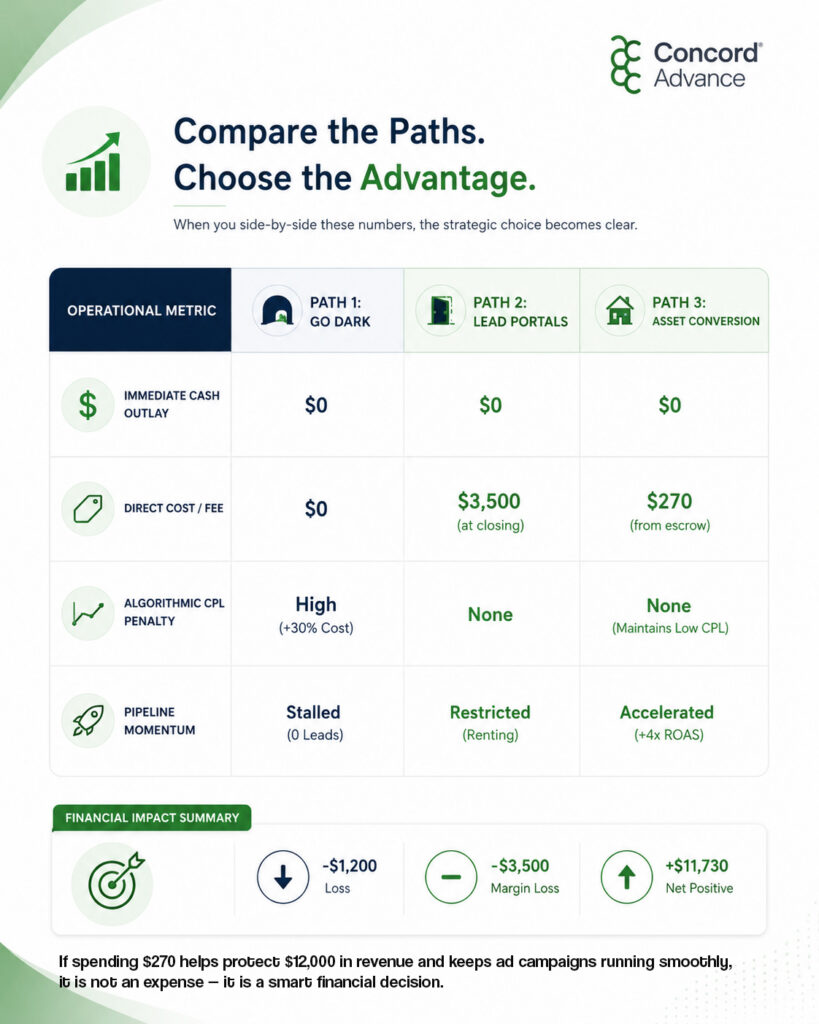
By utilizing asset conversion strategically, you are no longer at the mercy of the calendar.
You gain the operational freedom to treat your future revenue as a tool you can wield today, ensuring that your infrastructure remains completely decoupled from the unpredictable timing of the local title office.
The Arbitrage of Momentum: Capitalizing Your Entire Ecosystem
Decoupling your operational infrastructure from the unpredictable timing of the local title office allows you to protect more than just your digital ad accounts.
While maintaining an “always-on” presence in Meta and Google is vital, algorithmic decay is only one piece of the puzzle.
True marketing liquidity is about having the cash on hand to fund the non-negotiable, offline, and human elements of your business that build long-term brand equity.
When cash flow becomes lumpy, the damage ripples across your entire ecosystem. Here is how strategic liquidity allows you to scale using high-leverage use cases far beyond paid digital ads:
1. Preserving Physical Geographic Farming
In 2026, dominating a neighborhood relies on multi-channel consistency where physical direct mail is closely synced with local digital data.
This hyper-targeted frequency relies entirely on uninterrupted data and print queues.
If a 45-day escrow bottleneck forces you to pause your mail fulfillment or let your local neighborhood sponsorships lapse, the entire campaign sequence breaks.
In a tight market, a single missed month allows a competing agent to step into that data loop, breaking your consistency and causing you to lose the cumulative mindshare you spent thousands of dollars building over the last year.
Strategic liquidity keeps your print automation active and your local brand top-of-mind without a single day of downtime.
2. High-Production Content & Listing Media
In 2026, a listing is a multi-media lead magnet to win your next three listings.
Securing a new client requires upfront capital for premium assets: cinematic walk-through videos, 3D interactive tours, and high-end staging.
>
With immediate liquidity, you can quickly engage professional media teams, allowing every listing to showcase a refined, luxury-level presentation from day one.
3. Retaining and Safeguarding Your Human Capital
By leveraging your time and hiring a transaction coordinator, an Inside Sales Agent (ISA), or an administrative assistant, you naturally transition from working as a solo producer to building a professional enterprise.
That said, high-quality talent expects consistent and timely compensation.
They are unlikely to accept delayed payments or net-60 terms while waiting for issues like title disputes to resolve.
Liquidity allows you to meet payroll reliably on schedule, which helps attract and retain exceptional team members who remain loyal and fully focused on delivering results.
4. Capitalizing on High-Touch Database Marketing
Pop-by gifts, hyper-personalized closing tokens, and exclusive client appreciation dinners cannot be bought on credit without eroding your margins.
When cash flow tightens, these experiential branding plays are usually the first to be cut.
Yet, cutting them directly starves your future referral pipeline.
Maintaining a steady flow of liquidity allows you to execute these high-value touchpoints precisely on schedule, turning past clients into an active, outbound sales force.
Conclusion: From Transactional Agent to Enterprise Founder

The feast-or-famine cycle that plagues the real estate industry is a structural flaw in how agents manage capital.
If you wait for a title company to clear a check before you fund your next growth initiative, you are letting the calendar dictate your business velocity.
In 2026, the market moves too fast, and operational systems decay too quickly to tolerate a business model built on constant pauses.
By understanding the math behind the Cost of Stagnation and setting up a data-driven Weighted Runway, you shift from a reactive state of survival to a proactive state of leverage.
Whether you choose to utilize retained earnings, a clean line of credit, or a strategic commission asset conversion, the goal remains identical: never let your business infrastructure go dark.
When capital moves at the exact same speed as your data, the friction of real estate scaling disappears.
Frequently asked questions
1. How do I factor an advance into my overall cash flow plan?
Think of it as one tool within a broader architecture. A 30 to 45 day operating reserve handles routine gaps. Pipeline diversification smooths income across the calendar. A commission advance handles the specific situation where a deal is in flight, the timing is off, and you need capital to keep the business moving without disrupting the systems that drive your next transaction. Used together, these tools largely eliminate the feast and famine cycle that catches most agents off guard.
2. What is the ‘Income Illusion’?
It’s the disconnect between what you’ve earned and what you can actually access. Your pipeline looks healthy, your deals are moving, but your bank account doesn’t reflect any of it yet, and your business expenses don’t wait for escrow to close. Recognizing this as a timing problem, not a production problem, is the first step toward fixing it.
3. Why shouldn’t I cut my marketing budget when cash gets tight?
Because cutting your marketing spend during a slow period directly creates the next slow period. Lead generation has a lag. The deals closing 60 to 90 days from now are a direct result of what you’re doing in the market today. Protecting your marketing budget the same way you protect fixed operating costs is one of the most important cash flow decisions you can make.
4. Is cash flow management mostly about discipline?
Less than most people assume. Discipline helps, but the agents who eliminate the feast and famine cycle aren’t necessarily more disciplined; they’ve built better architecture. The right reserve size, a diversified pipeline, protected marketing spend, and proper tools remove the decision points where discipline would otherwise be required. Good systems make consistent cash flow the default, not the exception.
5. What is pipeline diversification and why does it matter?
If you work exclusively in one property type or price range, your deals tend to close in the same narrow window which means income arrives in one large wave followed by a long dry stretch. Intentionally mixing buyer-side transactions, seller listings, and referral income creates deals that close on different timelines. That staggering effect smooths your monthly cash flow considerably over the course of a year.

