
 A commission advance gives real estate agents early access to a pending commission. What it costs depends on three things: the fee model the provider uses, the size of the advance, and in some cases, how far out the closing date is.
Key Takeaways
- Commission advance providers charge either a flat fee or a percentage of the advance amount.
- Percentage-based fees typically range from 5% to 15% of the advance amount.
- Some providers factor the closing timeline into their pricing.
- A flat fee stays fixed regardless of the advance amount, making the cost predictable across transactions of any size.
- Additional charges such as wire fees or application fees vary by provider and can add to the total cost.
The Two Fee Models
Every commission advance fee falls into one of two structures.
Percentage-based pricing:
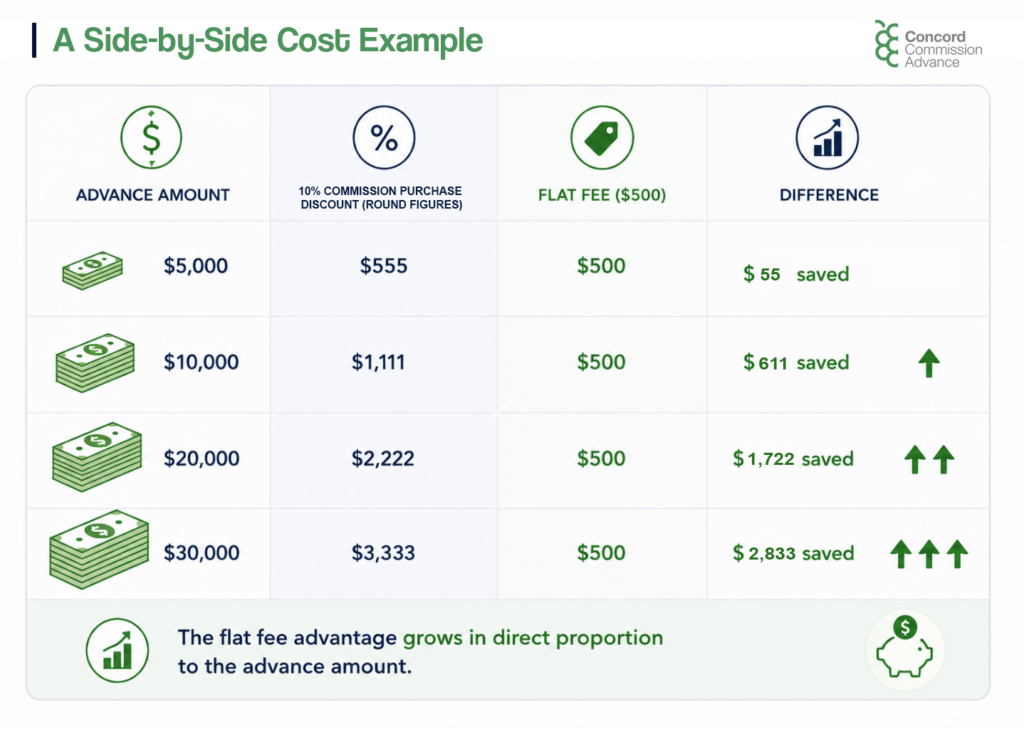
The provider buys a piece of your future commission at a discount. For example, say a company offers you a $10,000 advance at a 10% discount rate. To give you that $10,000 today, they’d actually purchase $11,111.11 worth of your future commission.
Flat-fee pricing.
The provider charges a fixed fee regardless of the advance size. An agent advancing $10,000 and an agent advancing $20,000 pay the same fee. The cost does not increase as the advance amount grows.
Additional Charges to Be Aware Of
Beyond the primary fee, some providers include additional charges that affect the total cost.
Wire transfer fees.
Some providers charge a fee to wire funds to the agent’s bank account. This typically ranges from $15 to $35 per transaction and is sometimes waived for ACH transfers.
Application fees.
These are less common, but some providers charge a fee to process the application regardless of whether it is approved.
Extension fees.
If a closing date is delayed beyond the date stated at the time of the advance, some percentage-based providers charge an additional fee for the extended period. Agents in markets with unpredictable closing timelines should always confirm whether the initial fee covers delays before signing.
How to Calculate the True Cost of an Advance
The total cost of a commission advance accounts for the following:
- The primary fee: flat or percentage, as quoted
- Any wire or transfer fees: added to the primary fee
- Any extension fees: applicable if the closing date shifts
- The net payout: the advance amount minus the primary fee and any additional charges
Example: An agent advances $15,000 at a 10% fee. The provider also charges a $25 wire fee. Total cost: $1,525. Net payout to the agent: $13,475.
On the same advance with a flat fee of $500 and no wire fee: total cost $500, net payout $14,500. A difference of $1,025 on a single transaction.
What Agents Often Overlook
Advances are not loans.
Because no interest accrues, comparing a commission advance fee to a loan interest rate is not a straightforward calculation. The fee is a one-time fixed cost, not a rate that compounds over time.
The closing timeline affects percentage-based fees more than flat fees.
An agent on a percentage-based model who experiences a delayed closing may pay more than initially quoted, depending on the provider’s extension policy. A flat fee is immune to that variable.
The fee is charged on the advance amount, not the full commission.
An agent with a $20,000 commission who advances $12,000 pays the fee only on the $12,000. The remaining $8,000 is received at closing with no fee applied.
Common Questions
Are commission advance fees negotiable?
Some providers offer reduced rates for repeat clients or high-volume agents. It is worth asking, particularly for agents who advance commissions multiple times per year.
Does the fee change if the deal closes early?
Under a flat fee model, early closing has no effect on the cost. Under some percentage-based models, early closing may result in a partial refund. This varies by provider and should be confirmed before signing.
Is the commission advance fee tax deductible?
When used for business purposes, the fee generally qualifies as a deductible business expense. A licensed tax advisor should confirm the treatment specific to each agent’s situation.
Does the advance amount affect eligibility?
Most providers set a maximum advance as a percentage of the net commission, typically between 50% and 75%. Whether the remaining portion is held until closing or disbursed sooner varies by provider.
The Bottom Line
The cost of a commission advance is determined by the fee model, the advance amount, the closing timeline, and any additional charges the provider applies. Percentage-based fees are the most common structure in the industry and produce higher costs as the advance amount grows. Flat fees remain constant regardless of advance size, making them more predictable and, on larger advances, meaningfully less expensive.
Before selecting a provider, agents benefit from requesting a full cost breakdown on their specific transaction: primary fee, transfer fees, and any extension policy. The difference between providers, on a single advance, can run into hundreds or thousands of dollars.
Concord Advance purchases a portion of the agent’s pending commission at a discount rate determined by the time remaining until closing. A deal closing within 30 days carries a lower rate than one closing in 60 days. Full pricing is published here. Applications are completed online at concordadvance.com.

