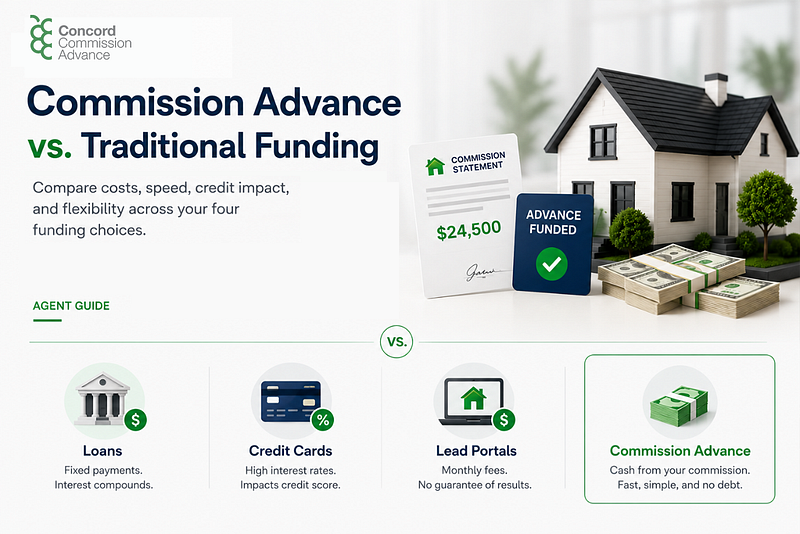
 Real estate agents commonly turn to one of four options when managing cash flow between closings: a commission advance, a personal or business loan, a credit card, or a lead portal. Each option carries a different cost structure, a different impact on credit, and a different set of trade-offs.
Key Takeaways
- A commission advance provides immediate access to a portion of a commission already earned on a pending transaction.
- Personal loans deliver a lump sum repaid in fixed monthly installments, typically over one to five years.
- Credit cards offer revolving access to funds up to a set limit, with interest charged on any balance not paid in full each month.
- Lead portals convert current cash into future pipeline activity.
- Credit score is a qualifying factor for both personal loans and credit cards.
The Four Options at a Glance
Before comparing them directly, it helps to understand what each option actually is.
Commission Advance: A commission advance allows an agent to access a portion of a pending commission before the transaction closes. The advance company purchases a portion of the expected commission at a fee. At closing, the broker or closing agent splits the commission automatically, one portion goes to the advance company, the remainder goes to the agent.
Personal or Business Loan: A personal or business loan provides a lump sum of cash repaid over a fixed period through monthly installments. Loan terms typically range from one to five years, and interest rates vary based on the applicant’s credit score, income, and existing debt obligations.
Credit Card: Credit cards offer revolving access to funds up to an approved credit limit. Unlike a loan, there is no fixed repayment term. The agent makes a monthly minimum payment, with the option to pay more or in full. Interest is charged only on the balance that remains unpaid at the end of each billing cycle.
Lead Portal: Lead portals such as Zillow Premier Agent and Realtor, charge agents a recurring monthly fee in exchange for leads in a designated market or zip code. Unlike the other options in this comparison, a lead portal does not provide cash. It converts existing cash into future pipeline activity.
Head-to-Head Comparison
Cost
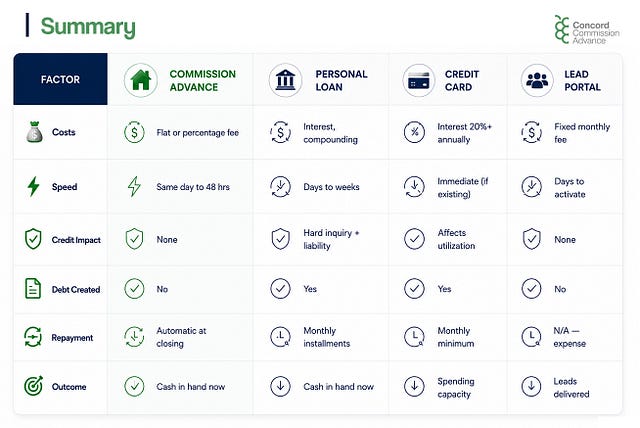
Commission Advance: The cost is a flat or percentage-based fee charged once on the amount advanced. There is no compounding. The total cost is known before the agent signs anything.
Personal or Business Loan: Personal and business loans charge interest on the outstanding balance, compounding monthly. A $10,000 loan at 10% annual interest repaid over two years costs approximately $1,100 in interest by the time the final payment is made, and that figure rises with the rate and the repayment period.
Credit Card: Credit cards charge interest on any balance not paid in full by the end of the billing cycle. The average credit card interest rate in the United States exceeds 20% annually. An agent carrying a $5,000 balance for six months at that rate accrues over $500 in interest alone on top of the original expense.
Lead Portal: Lead portals charge a recurring monthly fee regardless of results. An agent paying $1,000 per month receives leads, but there is no guarantee those leads close. The cost is fixed whether the pipeline converts or not.
Speed of Access
Commission Advance: Funds are typically available within 24 to 48 business hours of approval. Same-day funding is available through select providers.
Personal or Business Loan: Bank loan approvals involve underwriting, documentation review, and processing periods. Online lenders typically approve and fund personal loans within one to five business days. Traditional banks and credit unions may take longer (approval alone can take up to a week, with funding arriving one to five business days after that).
Credit Card: Existing credit card balances are accessible immediately. Applying for a new card introduces a waiting period of 7 to 14 business days for delivery and activation.
Lead Portal: Lead portals begin delivering leads once the subscription is active (typically within days of payment). However, lead-to-commission timelines in real estate average 3 to 6 months from first contact to close.
Impact on Credit
Commission Advance: A commission advance does not appear on a credit report. No hard inquiry is conducted. The agent’s debt-to-income ratio is unaffected, which preserves the ability to qualify for a mortgage or other personal financing.
Personal or Business Loan: Loan applications trigger a hard credit inquiry, which temporarily reduces the agent’s credit score. The loan balance appears as a liability on the credit report for the duration of repayment.
Credit Card: Credit utilization (i.e. how much of the available credit limit is in use) accounts for approximately 30% of a FICO credit score. High utilization from business expenses can meaningfully reduce an agent’s score over time.
Lead Portal: Lead portals do not interact with credit in any way. They are a straightforward business expense, paid by card or bank transfer.
Risk
Commission Advance: The primary risk is a deal falling through after the advance is issued. Most advance companies work with the agent to recover the advance from the next closed transaction rather than requiring immediate repayment.
Personal or Business Loan: Monthly payments are due regardless of whether deals close that month. Missed payments affect credit standing and can trigger penalties.
Credit Card: Unlike a loan, a credit card has no fixed end date. An agent who carries a balance through two or three slow months will owe interest on that balance each cycle. The longer it remains unpaid, the more it costs.
Lead Portal: Lead portal fees are charged monthly regardless of how many leads convert. Portal leads are not guaranteed to convert, and in residential real estate, the average lead-to-close timeline runs three to six months.
Control
Commission Advance: The agent decides when to apply, how much to advance, and how to use the funds. The money can go toward any business or personal expense without restriction.
Personal or Business Loan: Some loans specify permitted uses, particularly business loans. Funds are disbursed in a lump sum with no flexibility in repayment timing.
Credit Card: Spending is flexible and unrestricted. However, the ease of access can result in higher balances than intended, particularly during slow markets.
Lead Portal: Control over lead quality, volume, and conversion rate sits with the portal. The agent cannot influence which leads are delivered or how competitive the zip code becomes if other agents increase their spend.
Which Option Fits Which Situation
Agent with a deal under contract who needs immediate cash flow
A commission advance is the most direct solution. The money is already earned, accessing it early through an advance is faster, simpler, and less costly than taking on debt through a loan or credit card.
Agent building a long-term marketing infrastructure
A business loan may be appropriate when the investment is large, the repayment timeline is defined, and the agent has stable income to support monthly payments.
Agent managing routine business expenses between closings
A credit card works for small, predictable expenses, provided the balance is paid in full each month. When balances carry over, the cost of credit card financing rises sharply.
Agent looking to grow a pipeline in a new market
A lead portal is designed for exactly this use case. The trade-off is cost certainty without outcome certainty and a lead-to-close timeline that can stretch across several months.
Agent who needs flexibility without affecting credit standing
A commission advance is the only option in this comparison that creates no debt, conducts no credit inquiry, and leaves no footprint on a credit report.
The Bottom Line
Each of these options moves money differently and carries a different cost structure. The right choice depends on what the agent needs. Understanding the actual cost of each option, before committing to one, is what separates a sound financial decision from an expensive one.
Concord Advance provides flat-fee commission advances to real estate agents and brokers nationwide. Applications are completed online at concordadvance.com.

