
January 28th, 2026
Embarking on Your First Commission Advance: Everything Smart Agents Need to Know (FAQ Hub)
Jumping into the world of real estate comes with thrilling firsts: your first listing, your first closed deal, and, for many agents, your first commission advance. Navigating the commission advance process can feel overwhelming, especially if you’re a new realtor seeking stability in your cash flow between closings. The good news? A commission advance can bridge timing gaps without tying you down financially, provided you understand how it works and ask the right questions before signing a commission advance agreement.
This comprehensive FAQ hub walks you through everything first-timers need to know about commission advances for realtors. From understanding the basics to choosing the right provider and clarifying contract terms, this guide arms you with the knowledge to ensure your first experience is smooth, secure, and supports your career growth.
What Is a Commission Advance for Realtors?
A commission advance for realtors is a financial tool that allows agents to receive a portion of their earned commission before the actual real estate transaction closes. In simple terms, it’s like getting a paycheck in advance, based on your pending commission from a firm sale.
Consider this scenario: You’ve closed a deal, but escrow drags on, or the closing isn’t scheduled for several weeks. If you need immediate access to your commission for marketing, bills, or investing in your business, a commission advance can be the answer. In exchange for an upfront fee, a third-party provider advances you a portion of your expected commission. When the transaction closes, the advance is paid back directly from the commission at settlement.
Why Do Realtors Use Commission Advances?
Cash flow challenges are common in real estate. Even the most successful agents face periods where incoming commission lags behind expenses. Here are some reasons realtors use a commission advance:
– Smoothing irregular income: Real estate income is rarely consistent. A commission advance helps balance out income delays between closings.
– Covering business costs: Need to pay for staging, marketing, or lead generation before the next closing? An advance helps you keep business moving.
– Handling personal expenses: Life doesn’t pause for paychecks. If you have urgent bills or financial obligations, an advance can offer relief.
– Investing in growth: Sometimes, the smart move is to invest in your business now—before your next commission actually clears the bank.
How Does a Commission Advance Agreement Work?
A commission advance agreement is a contract between you (the realtor) and an advance company. Here’s a step-by-step overview of the typical process:
– Application: You identify a pending sale with a signed purchase agreement and an estimated closing date. You apply to a commission advance company using basic deal information.
– Approval: The provider reviews your application and verifies the details with your broker. They assess the risk and determine eligibility.
– Agreement: You sign a commission advance agreement outlining the terms—how much you’ll receive, the fees involved, and the repayment process.
– Advance: Funds are deposited directly into your bank account, often within 24 hours of approval.
– Repayment: Upon closing, your commission is paid to the provider first. They deduct the amount advanced plus their fee; you receive the remainder.
Is a Commission Advance a Loan?
This is a common question, and the answer is important. A commission advance is not a loan. You’re not borrowing money in the traditional sense; instead, you’re selling a portion of your earned but unpaid commission. This is why commission advances don’t impact your credit score, require collateral, or follow banking regulations that loans do.
Instead, the advance is “secured” by the pending sale. If for some reason the deal falls through, most providers work with you to recover the funds, usually by transferring the advance to another pending transaction or allowing you to repay over time.
What Are the Costs Involved in a Realtor Commission Advance?
The cost of a commission advance comes in the form of a fee, sometimes called a “discount fee.” This fee is typically a percentage of the commission advanced, based on the duration until closing. Most reputable companies charge between 8 and 15 percent of the advanced amount for the typical 30-day escrow period. The longer the closing, the higher the fee may be.
Key questions about fees:
– Is there a flat fee or a sliding scale based on days until closing?
– Are there application or administrative fees in addition to the advance fee?
– Are there penalties for delayed closings or early repayments?
Always compare costs between providers and never hesitate to ask for an all-in breakdown before agreeing.
Who Qualifies for a Commission Advance?
Most commission advance providers have minimal eligibility requirements, but you typically need:
– A signed purchase agreement with a firm closing date.
– A commission that will be paid directly to your broker (not a private party).
– Good standing as an agent (no history of commission disputes or legal entanglements).
– Approval from your broker (some advance companies need your broker to co-sign or acknowledge the agreement).
Good news for new agents: You don’t necessarily need years of experience or a minimum number of closed deals to qualify for a commission advance, though some providers have limits for first-timers.
What Documents and Information Are Required?
Each provider has its own checklist, but you’ll often need:
- The fully executed purchase and sale agreement.
- The commission breakdown or agent commission statement.
- The settlement sheet (if closing is imminent).
- Broker contact information and approval.
- Your government-issued ID and banking details.
The initial application process is typically online and takes only a few minutes if you have your paperwork in order.
How Soon Can Realtors Receive Funds from a Commission Advance?
Speed is one of the biggest benefits of commission advances. Once your application is approved, most providers transfer funds via ACH within one business day, sometimes even the same day. If you’re in a real pinch, many companies offer expedited services for an additional fee.
What If the Transaction Falls Through?
Life happens—buyers back out, deals collapse. If your pending transaction doesn’t close as expected, here’s what usually happens:
– The advance provider will not pursue harsh collections as a traditional lender might.
– Most reputable companies give you the option to transfer the commitment to another pending deal, or they’ll work out a repayment arrangement over time.
– The risk is shared between you and the advance company. Reading the fine print in your commission advance agreement is key to understanding your obligations.
How Much of My Commission Can I Advance?
Most companies will advance up to 80 percent of your expected net commission, sometimes more but rarely the full amount. They keep a buffer to protect themselves in case of unexpected closing costs or commission disputes.
Questions to Ask:
- What’s the maximum I can advance per transaction?
- Is there a minimum amount?
- Are there volume discounts or tiered fee structures for multiple advances?
Do I Need My Broker’s Approval?
In almost every case, yes. Your broker typically signs off on the commission advance agreement, since commissions are paid to brokers directly. Some brokerages already have a relationship with an advance provider, which can speed up the process and possibly lower the fees.
If you’re an independent broker or team leader, you’ll need to provide proof of your legal status and the business bank account where commissions are deposited.
Does My Credit Score Matter?
No—most commission advance companies don’t run a credit check or require a specific score. Approval is based on the strength of your pending transaction, not your financial history. This makes advances appealing to new agents, seasoned pros, and everyone in between.
Is a Commission Advance Right for Every Realtor?
While commission advances are helpful, they’re not a one-size-fits-all solution. Consider the following before proceeding:
– Frequency of use: Leaning on advances too often can shrink your net income. Use them strategically, not as a routine business practice.
– Fees: Compare the cost of the advance to alternative funding options, such as credit cards or business lines of credit. Sometimes, your brokerage may offer internal advances with lower fees.
– Financial health: Look at your broader financial picture. If you’re consistently in need of advances, it may be time to reassess your business expenses or commission split.
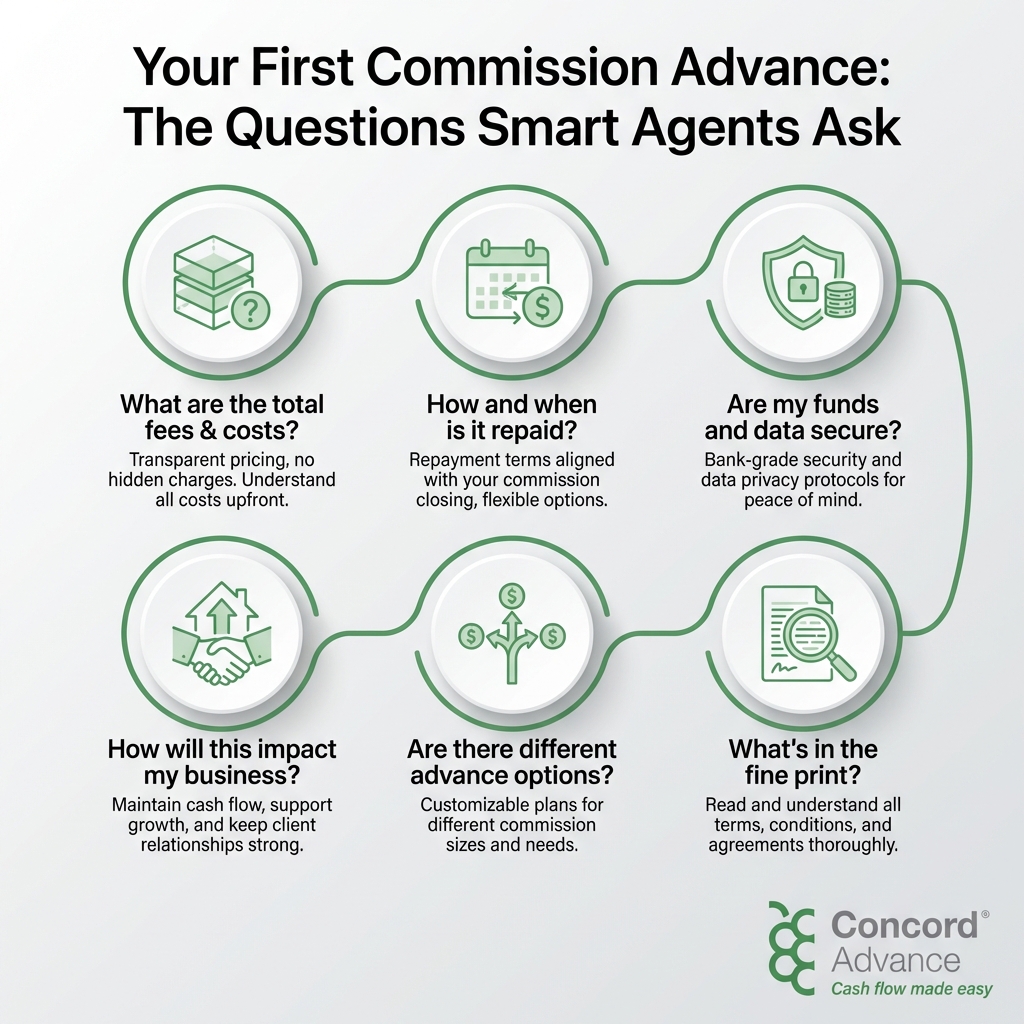
The Questions Smart Agents Ask Before Signing a Commission Advance Agreement
As with any financial agreement, due diligence is crucial. Before you sign a commission advance agreement, savvy agents ask:
- What’s the total cost of the advance, and are there any hidden fees?
- How quickly will I receive funds?
- What happens if the deal is delayed or falls through?
- What’s the maximum and minimum amount I can advance?
- Are there penalties for early repayment?
- How is my information protected, and is the provider regulated?
- Does my broker need to be involved in the process?
If you can’t get clear, straightforward answers to these questions, consider another provider.
Common Myths and Misconceptions About Real Estate Commission Advances
Let’s debunk a few myths that often pop up among agents considering their first commission advance:
Myth: Only struggling agents use commission advances.
Fact: Successful agents use advances for cash flow management, strategic investments, or to capitalize on time-sensitive opportunities.
Myth: Commission advances are loans that hurt your credit.
Fact: They’re not loans, don’t require a credit check, and don’t impact your credit score.
Myth: The fees are too high to be worth it.
Fact: When used strategically, the cost of a commission advance can be justified by the business or personal flexibility it provides.
Myth: Advance providers are loan sharks.
Fact: Reputable commission advance companies are transparent, regulated, and focused on supporting realtors as valued clients.
How to Choose the Best Commission Advance Company
Not all commission advance providers are created equal. As a first-time user, keep these criteria in mind when making your selection:
Reputation: Look for providers with strong reviews, testimonials from fellow agents, and a history in the real estate industry.
Transparency: The company should clearly outline its fees, process, and support options—no hidden costs or complicated fine print.
Support: Responsive customer service is crucial, especially if you’re working against tight deadlines.
Experience: Choose a provider that specializes in realtor commission advance services, not a general factoring company.
Speed: Many companies tout same-day or next-business-day funding. Read the details to ensure promises match reality.
Security: Your financial and transaction information must be handled confidentially and securely.
Broker Relationships: If your brokerage already has a preferred provider, you may be eligible for custom discounts or expedited approval.
Practical Tips for First-Time Users of Realtor Commission Advance Services
Ready to dive in? Here are some practical recommendations for your first advance:
Double-check deal information: Mistakes on the sales agreement or commission breakdown can delay approval.
Understand the agreement: Ask for clarification if there’s jargon or sections you don’t understand.
Limit advances to necessary amounts: Only advance what you truly need to keep fees manageable.
Monitor deal timelines: Communicate proactively with your broker and advance provider if closing dates shift.
Keep records: Maintain copies of all agreements and correspondence for your files.
Ask for repeat client perks: Many providers offer lower fees or bonus features for returning clients.
Alternatives to a Realtor Commission Advance
Commission advances are powerful tools, but not the only option. Explore these alternatives to round out your financial strategy:
Broker advances: Some brokerages offer their own advance programs, often with lower fees.
Business line of credit: For ongoing expenses, a credit line may offer more flexible terms, though approval and interest rates vary.
Personal savings: Building an emergency fund helps weather periods between closings.
Short-term loans: Sometimes credit cards or small business loans may offer comparable fees but with stricter approval criteria and potential credit impact.
Peer-to-peer lending: Some agents tap into trusted networks for short-term loans, though this approach lacks the structure and protections of an advance agreement.
Frequently Asked Questions From First-Time Commission Advance Users
How fast can I get my funds?
Most agents receive funds by direct deposit within 24 hours of final approval. Some providers offer wires or expedited options for urgent needs.
Can I apply if I have multiple pending deals?
Absolutely. Many agents spread advances across several transactions for maximum flexibility, but keep in mind your provider may set a cap on the total advanced amount at any one time.
Is the process confidential?
Yes. Reputable commission advance companies maintain strict confidentiality about advances. Your broker, however, will be involved in the transaction.
Do I have to pay if my deal doesn’t close?
Policies vary. Most providers will let you trnsfer the advance to another pending deal or work out a manageable repayment plan if your primary transaction collapses.
Will my tax situation be affected?
A commission advance is not additional income; it’s receivables sold in advance. Your earnings and reporting for tax purposes remain unchanged, but always check with your CPA for specifics.
Can teams or brokers use commission advances?
Yes. Teams and brokerages can often use commission advances for group transactions, office expenses, or to float operating capital.
Building Your Real Estate Business With Smarter Cash Flow
Mastering cash flow is one of the defining skills of top-producing agents. Used wisely, a commission advance for realtors puts power back in your hands—letting you take control of unpredictable income cycles and invest confidently in your growth.
If you’re considering your first commission advance, remember:
- Do your research on providers and compare costs.
- Ask smart questions about every agreement you sign.
- Limit advances to essential needs to maximize your net income.
- See advances as a tool in your broader business-building strategy—not a crutch.
With the right information and the right partner, your first commission advance won’t just be a bridge; it will be a springboard to new opportunities, steadier success, and a business that thrives no matter where the market cycle takes you.

