
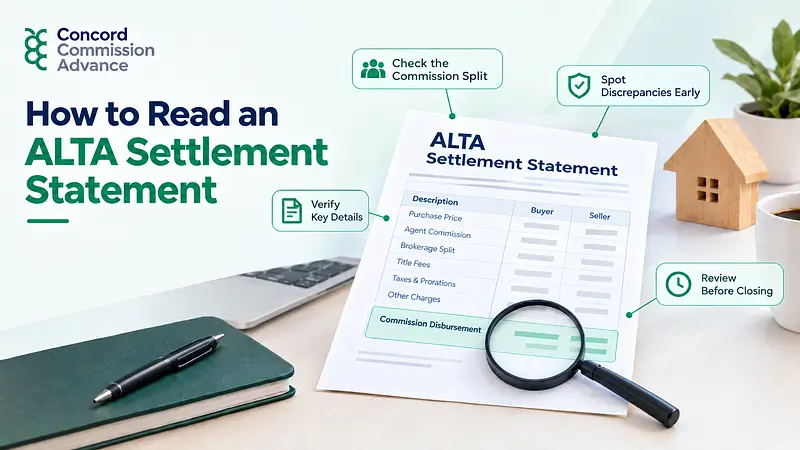
The ALTA settlement statement is one of the most important documents in any real estate transaction. Most agents receive it at or near closing, scan for their commission line, and move on. Agents who read it carefully before the closing date protect themselves from disbursement errors, commission discrepancies, and last-minute surprises that are significantly easier to resolve before the closing table than after.
This guide explains what an ALTA settlement statement is, how it is organized, what each section means, and specifically what agents should verify before their commission is disbursed.
Key Takeaways
- The ALTA settlement statement is a comprehensive record of every financial transaction in a real estate closing: who paid what, who received what, and how funds were distributed.
- The commission line on the ALTA reflects the gross commission and how it is split. Agents should verify this matches their brokerage agreement and any referral or advance arrangements in place.
- An error on the ALTA does not correct itself at closing. Discrepancies must be flagged to the title company before funds are disbursed.
- When a commission advance is in place, the advance company appears as a separate payee on the ALTA. Agents should confirm the amount matches their advance agreement before closing day.
- The ALTA is typically available for review 24 to 48 hours before closing.
What the ALTA Settlement Statement Is
The ALTA settlement statement is a standardized document prepared by the title company or closing attorney that itemizes every financial component of a real estate transaction. It shows the buyer’s costs, the seller’s proceeds, and the disbursement of all funds, including commissions, taxes, fees, and payoffs.
Unlike the Closing Disclosure, which is a lender-facing document prepared for financed transactions and focused on the buyer’s loan terms, the ALTA settlement statement is a comprehensive ledger of the entire transaction covering all parties and all funds.
In cash transactions, the ALTA is often the primary closing document. In financed transactions, both the Closing Disclosure and the ALTA are prepared.
How the ALTA Is Organized

The ALTA is divided into columns representing the buyer and the seller, each with charges and credits applied to their side of the transaction. A third column typically shows the description of each line item.
The major sections include:
Financial summary at the top. The document opens with the total transaction amount (the purchase price) and the net proceeds or cash due for each party. This summary figure is the result of everything itemized below it.
Seller side charges and credits. The seller’s column shows the purchase price as a credit, then deducts all seller-paid costs like agent commissions, outstanding liens, property taxes prorated to the closing date, transfer taxes, and any seller-paid concessions. What remains after these deductions is the seller’s net proceeds.
Buyer side charges and credits. The buyer’s column shows the loan amount and any credits as offsets against their total costs like purchase price, lender fees, prepaid taxes and insurance, title insurance, and closing costs. What the buyer owes after credits is the cash to close.
Disbursements section. Below the summary, the ALTA details where every dollar goes. Payoffs to existing lenders, commission disbursements, title company fees, recording fees, and any other parties receiving funds at closing are all included here.
The Commission Lines: What to Look For
The commission section of the ALTA is where agents focus their review. Several elements require verification before the statement is finalized.
Gross commission amount. The total commission agreed upon in the listing or buyer representation agreement should match the figure on the ALTA. The calculation is typically the purchase price multiplied by the commission percentage. Verify that the purchase price used in this calculation reflects the final agreed-upon price and not an earlier figure from a prior version of the contract.
Commission split between brokerages. The ALTA shows how the gross commission is divided between the listing brokerage and the buyer’s brokerage. Both figures should match the split agreed upon in the listing agreement or buyer agency agreement.
Agent’s net disbursement. The ALTA will show what is disbursed to the brokerage. This does not necessarily include the individual agent’s net after the brokerage split. The agent’s net is determined by their compensation agreement with the broker, which is applied at the brokerage level after the commission is received from the title company. What the agent should verify on the ALTA is that the brokerage receives the correct gross amount.
Referral fees. If the transaction involved a referral from another agent or referral company, the referral fee should appear as a line item directing a portion of the commission to the referring party. Agents should confirm that any referral obligation is accurately reflected and directed to the correct payee.
Commission advance payee. If the agent has taken a commission advance on the transaction, the advance company appears as a named payee in the disbursements section. The dollar amount directed to the advance company should match the principal amount in the advance agreement exactly, with no variation.. Any discrepancy between the ALTA and the advance agreement should be flagged to the title company before closing so the disbursement instruction can be corrected.
Common Errors to Watch For
The ALTA is prepared by the title company based on information provided by the parties, the lender, and the brokerage. Errors are not uncommon, particularly on transactions with multiple parties, non-standard commission arrangements, or last-minute changes.
Wrong purchase price in the commission calculation. If the purchase price was renegotiated after the contract was originally executed, the commission calculation should reflect the final agreed price. An ALTA prepared from an earlier version of the contract may use the wrong figure.
Incorrect brokerage split. The split between listing and buyer’s brokerage should match the offer of compensation agreed to in the transaction. If the split was negotiated differently than the MLS listing stated, as is now common post-NAR settlement, the ALTA should reflect the agreed terms, not the original MLS figure.
Missing or incorrect referral payee. Referral fees that are verbally agreed to but not formally documented in writing before closing are the most common source of commission disbursement disputes. Any referral arrangement should be documented and provided to the title company before the ALTA is prepared.
Advance company amount does not match the agreement. If a commission advance is in place, the advance company’s payee amount on the ALTA should match the principal amount in the advance agreement. Even a small discrepancy can create a reconciliation issue after closing.
Prorations calculated incorrectly. Property tax prorations (the division of the annual tax bill between buyer and seller based on the closing date) can be miscalculated if the title company uses an incorrect tax figure or proration date. While this affects the seller’s proceeds rather than the commission directly, a significant proration error can affect the seller’s net and prompt post-closing disputes that involve the agent.
When to Request the ALTA
The ALTA is typically finalized 24 to 48 hours before closing. Agents should request it proactively instead of waiting for the title company to distribute it on the day of closing.
Reviewing the ALTA the day before closing gives the agent time to flag errors to the title company and have them corrected before the disbursement is made. An error discovered at the closing table is significantly more difficult to resolve. In some cases, disbursements cannot be reversed on the same day, and corrections require additional processing time after closing.
The standard practice for agents who close multiple transactions per year is to request the ALTA as soon as it is available, review the commission section against the original brokerage agreement and any advance or referral arrangements, and confirm in writing with the title company that any corrections have been made before closing day.
How the ALTA Differs from the CDA
Agents who work with a Commission Disbursement Authorization may notice that the CDA and the ALTA serve related but distinct purposes.
The CDA is the broker’s instruction to the title company specifying who receives what portion of the commission. The ALTA is the title company’s comprehensive record of every financial component of the transaction, including the commission, but also every other cost and credit.
The two documents should be consistent with each other. The commission disbursement shown on the ALTA should match exactly what the CDA instructs. If they do not align, the discrepancy should be resolved before closing.
The CDA and its role in commission disbursement is covered in detail in [A Beginner’s Guide to Reading Your Commission Disbursement Authorization].
Common Questions
Who prepares the ALTA?
The title company or closing attorney prepares the ALTA based on information provided by all parties to the transaction.
Can an agent request changes to the ALTA?
An agent who identifies an error on the ALTA should contact the title company promptly. The title company will verify the discrepancy and issue a corrected statement if the error is confirmed. Agents cannot unilaterally change the ALTA. Corrections go through the title company and require supporting documentation.
What if the ALTA is not available before closing?
Some title companies do not finalize the ALTA until the day of closing. In those cases, agents should request a draft or preliminary version of the commission section as early as possible. Even an informal confirmation of the commission figures from the closing agent provides an opportunity to catch errors before disbursement.
The Bottom Line
The ALTA settlement statement is the financial record of the transaction and for agents, the document that determines exactly what is disbursed to the brokerage at closing. Reviewing it before closing day, verifying the commission figures against the brokerage agreement, confirming any referral or advance payees, and flagging errors to the title company before disbursement is the standard practice of agents who close consistently without commission disputes. An error found before closing costs minutes to correct. An error found after closing can take days or weeks.
The advance amount, payee name, and disbursement instructions for any Concord Advance are documented in writing at funding, giving agents exactly what they need to verify the ALTA before closing day. Applications are completed online at concordadvance.com.


