
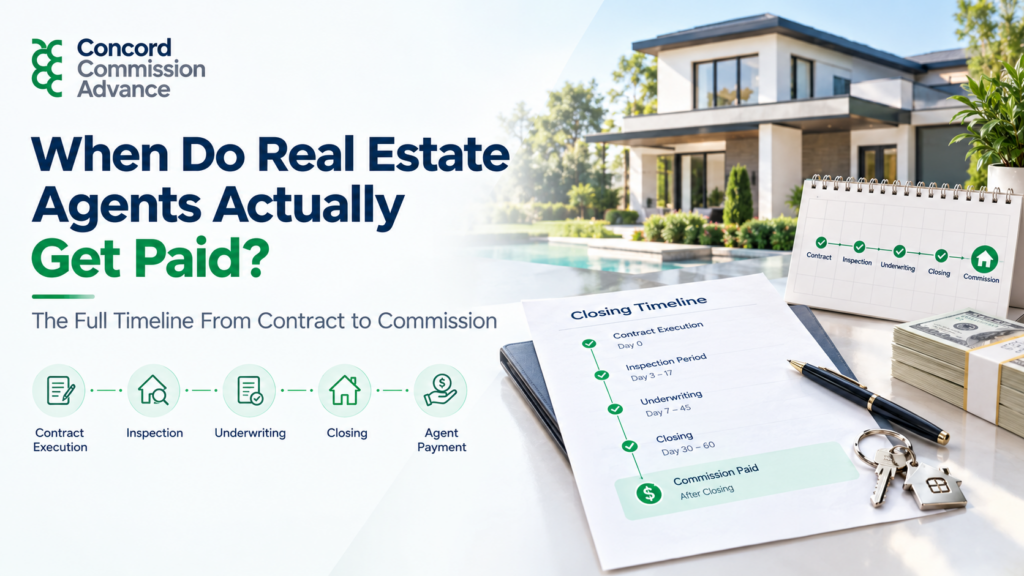
The moment a purchase contract is signed, the agent’s work on that transaction is largely complete. The commission, however, is not. Between a signed contract and a funded commission, every real estate transaction moves through a defined sequence of events, each with its own timeline, potential for delay, and its own effect on when the agent actually receives their money.
This guide walks through the full timeline from contract to commission, stage by stage, so agents understand exactly where their commission is at any point in the process and what can extend that timeline beyond the original estimate.
Key Takeaways
- A signed contract does not mean an imminent commission. The average residential transaction takes 30 to 60 days from contract to close and the commission is not disbursed until after the closing is complete.
- Each stage of the transaction has its own timeline and its own potential for delay.
- The commission is disbursed at closing by the title company or closing attorney, per the broker’s written authorization. The agent receives their portion through the broker, not directly from the title company.
- Brokerage processing time after closing, i.e. the period between the title company disbursing to the broker and the broker paying the agent, adds additional time that varies by brokerage.
- Understanding each stage of the timeline is what allows an agent to accurately forecast when a commission will arrive.
Stage 1: Contract Execution
Typical timeline: Day 0
The transaction begins when both buyer and seller have signed the purchase agreement and all parties have received a fully executed copy. From this moment, the contractual clock starts. Inspection deadlines, financing contingency periods, and the closing date are all measured from the execution date.
The agent’s commission is now tied to a specific transaction with a specific closing date. It is earned in the sense that the work to produce the contract has been done. It is not yet payable, since payment depends on the transaction closing successfully.
What can affect this stage: A contract that is not fully executed: missing initials, unsigned addenda, or a counteroffer that has not been formally accepted is not a binding contract. The timeline begins only when all signatures are in place.
Stage 2: Earnest Money Deposit
Typical timeline: Day 1 to Day 3
Within a defined period after contract execution (typically one to three business days) the buyer delivers the earnest money deposit to the escrow holder, which may be the title company, the listing brokerage, or a third-party escrow company depending on the state and the contract terms.
The earnest money signals the buyer’s commitment to the transaction. Its receipt is often a condition that must be confirmed before the inspection period and other contingency timelines begin running.
What can affect this stage: A delayed or missing earnest money deposit can create early transaction uncertainty and, in some states, gives the seller grounds to void the contract if not received within the specified window.
Stage 3: Inspection Period
Typical timeline: Day 3 to Day 17 (varies by contract)
The inspection period, commonly 7 to 14 days from contract execution depending on the state and the negotiated terms, gives the buyer the right to conduct a physical inspection of the property and, in most cases, to request repairs, negotiate a price reduction, or exit the contract based on inspection findings.
From the agent’s perspective, the inspection period is a contingency window. The transaction is under contract but not yet firm. A buyer who terminates during the inspection period triggers a contract cancellation, and the agent’s commission is not paid.
What can affect this stage: Inspection findings that prompt significant repair requests, a seller unwilling to negotiate on inspection items, or a buyer who uses the inspection period as an exit opportunity extend the uncertainty around whether the transaction will proceed to closing.
Stage 4: Lender Processing and Underwriting
Typical timeline: Day 7 to Day 45 (runs concurrently with other stages)
For financed transactions, the buyer’s lender begins processing the loan application after the contract is executed. This process involves document collection, income and asset verification, employment confirmation, and underwriting. This is the lender’s formal review of whether the buyer qualifies for the loan at the purchase price.
Lender processing is typically the longest single stage in a residential transaction and the one most commonly responsible for closing delays. It runs concurrently with inspection, appraisal, and title work. Underwriting is usually the last stage to complete before the clear-to-close is issued.
What can affect this stage: Incomplete buyer documentation, changes to the buyer’s employment or financial profile after application, lender pipeline volume, and the time required to resolve underwriting conditions all affect how long this stage takes. A request for additional documentation like a letter of explanation, additional bank statements, or updated pay stubs, can add days to the processing timeline.
Stage 5: Appraisal
Typical timeline: Day 10 to Day 25
For financed transactions, the lender orders an appraisal to confirm the property’s market value supports the purchase price. The appraiser inspects the property, pulls comparable sales, and delivers a report to the lender.
If the property appraises at or above the purchase price, the transaction proceeds. If it appraises below, the transaction must be renegotiated. The buyer either makes up the difference in cash, the seller reduces the price, or the parties find a middle ground. If no resolution is reached, the transaction may fall through.
What can affect this stage: Appraiser availability, the distance between the subject property and available comparable sales, and an appraisal that comes in below purchase price are the most common sources of delay or disruption at this stage.
Stage 6: Title Search and Insurance
Typical timeline: Day 7 to Day 30 (runs concurrently)
The title company searches the public record to confirm the seller has clear, marketable title to the property, free of outstanding liens, judgments, or ownership disputes. Title insurance is issued to protect the buyer and lender against any future claims on the title.
Title work runs concurrently with lender processing and appraisal. In most transactions, it is completed within the first half of the escrow period. In transactions with title complications like an estate sale, a property with multiple prior owners, or an unresolved lien, it can extend the timeline considerably.
What can affect this stage: Outstanding liens, unresolved judgments, easement disputes, or errors in the public record that require legal resolution before title can be cleared.
Stage 7: Clear to Close
Typical timeline: Day 25 to Day 45
The clear to close is the lender’s formal notification that all underwriting conditions have been satisfied and the loan is approved for funding. It is the last major milestone before the closing date is confirmed.
Once the clear to close is issued, the closing date is typically scheduled within a few days. The title company prepares the final closing documents, the ALTA settlement statement is finalized, and all parties are notified of the closing time and location.
For the agent, the clear to close is the signal that the commission is effectively secured, and barring a last-minute complication, the transaction will close and the commission will be disbursed.
What can affect this stage: Last-minute changes to the buyer’s financial profile, a final employment verification that reveals a job change, or a title issue identified late in the process can delay or prevent the clear to close from being issued on schedule.
Stage 8: Closing Day
Typical timeline: Day 30 to Day 60 from contract execution
On closing day, the buyer signs loan documents, the seller signs the deed and transfer documents, and the title company or closing attorney coordinates the disbursement of all funds. The ALTA settlement statement governs how every dollar is distributed including the commission.
The commission is disbursed from the seller’s proceeds to the brokerage per the broker’s written authorization, the Commission Disbursement Authorization. The title company executes the disbursement according to that authorization.
For a detailed breakdown of what happens to the commission at closing, including how commission advances are repaid and how the broker distributes the agent’s share, see Commission Advance Repayment Explained: What Happens at Closing.
Stage 9: Brokerage Processing
Typical timeline: Same day to 5 business days after closing
The title company disburses the commission to the brokerage at closing, but the agent does not necessarily receive their share on the same day. The time between the brokerage receiving the commission and the agent receiving their portion, i.e. the brokerage processing period, varies considerably by brokerage.
Some brokerages pay agents on the same day the commission is received. Others process agent payments on a weekly cycle. Larger brokerages with centralized accounting may take several business days to process and release agent disbursements after the closing file is reviewed.
What can affect this stage: The brokerage’s payment cycle, the completeness of the closing file submitted by the agent, and any compliance review the brokerage requires before releasing agent commissions all affect how quickly the agent is paid after closing.
Stage 10: Agent Payment
Typical timeline: Same day to 5 business days after closing
The agent receives their commission net of the brokerage split, any transaction fees, and any referral fee obligations via check, direct deposit, or wire transfer depending on the brokerage’s payment process.
This is the moment, typically 30 to 60 days after the contract was signed, and sometimes longer, that the agent’s commission actually arrives.

Why the Timeline Varies
The figures above represent typical timelines for standard residential transactions. Several factors push the timeline beyond these ranges:
Cash transactions close faster (often 14 to 21 days) because lender processing and appraisal are eliminated. The agent’s commission arrives sooner.
New construction closings are tied to completion dates that can be months beyond the original estimate. The agent’s commission does not arrive until the certificate of occupancy is issued and the closing occurs.
Short sales require lender approval of the sale price in addition to standard closing requirements. Lender review can add 30 to 90 days to the standard timeline.
Co-op transactions in New York require board approval before closing, adding 15 to 45 days to the standard timeline depending on the building’s review process.
Closing delays from any source, like a lender extension, a title issue, a last-minute contract amendment, push every subsequent stage back accordingly.
Common Questions
Is the agent’s commission secured once the contract is signed?
Not yet. The commission is contingent on the transaction closing. Until the clear to close is issued and the closing is complete, the commission can be lost if the transaction falls through.
Does the agent get paid at the closing table?
Rarely. The title company disburses to the brokerage, and the brokerage processes the agent’s payment separately, which may happen the same day or several business days after closing depending on the brokerage’s payment cycle.
What happens to the commission if the transaction falls through after the clear to close?
A clear to close is not a guarantee. If the transaction collapses after the clear to close due to a last-minute financing failure, a buyer who refuses to sign, or a title issue that cannot be resolved, the commission is not paid. The agent’s commission is only secured when funds are disbursed at closing.
Can an agent track where the transaction is in the timeline?
Yes. The agent or their transaction coordinator should have visibility into each stage of the process through the lender, the title company, and the brokerage. Proactively tracking the timeline, rather than waiting for updates, is the standard practice for agents managing multiple simultaneous transactions.
The Bottom Line
A real estate commission is earned at contract and paid at closing, with 30 to 60 days, sometimes longer, between the two. Understanding each stage of that timeline, what can extend it, and how long brokerage processing adds after closing gives agents an accurate picture of when their commission will actually arrive. This is what separates reactive cash flow management from deliberate financial planning.
Managing the gap between a signed contract and a received commission is one of the most common financial challenges in real estate. Concord Advance gives agents early access to pending commissions at a rate based on time to closing, without debt being created, or a credit check. Full pricing at concordadvance.com/rates-page/.

