March 23, 2026
How Realtors Really Use Commission Advances: Real-World Stories From the Field
For realtors, the unpredictable nature of deal cycles, escalating client expectations, and the always-looming gaps between closing and commission payouts create unique cash flow challenges. Commission advances have emerged as a powerful financial tool, helping real estate professionals at all career levels maintain agility, accelerate growth, and seize opportunities. But beyond the generic pitch, how do commission advance realtors actually use this resource in diverse, real-world scenarios? Let’s dive into authentic stories from the field, showing how agents, from fresh licensees to experienced luxury specialists, integrate commission advances into their business strategies.
Understanding Commission Advances in Real Estate
A commission advance is a financial service where a real estate agent sells a portion of their pending commission to a third-party company in exchange for immediate cash. Rather than waiting weeks or even months for a deal to close and record, agents can access a predictable portion of their expected earnings now, for a modest fee. This isn’t a loan, so credit checks are minimal and there’s no debt on the books. The advance provider is paid back directly from escrow post-closing.
Commission advance realtors find this model attractive because it aligns cash flow with business growth ambitions. Whether you’re ramping up marketing, hiring talent, or solving short-term cash crunches, the timing of a commission payout can unlock or limit what’s possible.
______________________________
Scenario-Based Stories: How Realtors Use Commission Advances
Let’s meet four realtors at very different career stages and see exactly how they use commission advances tactically.
______________________________
The New Agent: Bridging the Cash Flow Gap While Building a Pipeline
Meet Alex, six months into his real estate journey. While Alex was ambitious, networking, canvassing neighborhoods, and ramping up his digital presence, he quickly realized that the business of building a pipeline and closing that very first deal takes time. New agents like Alex often face several months with minimal income, even as business expenses mount.
Alex’s story illustrates a common use-case for commission advance realtors just starting out. When he landed his first pending buyer contract, the window until closing was 45 days. Alex had already invested heavily in self-branding materials, continuing education, and local sponsorships. As closing neared, a commission advance became a tactical bridge.
With an advance, Alex unlocked a portion of his upcoming commission immediately. This cash buffer allowed him to double down on generating new leads (paying for Facebook ads and open house events) instead of receding into financial caution. By the time his first deal closed, Alex already had two new contracts in escrow, growth made possible by judiciously leveraging a commission advance. For many commission advance realtors at the new agent stage, a timely cash infusion turns a one-deal month into a three-deal pipeline.
______________________________
Solo Agent: Smoothing Out Yearly Income and Seizing Time-Sensitive Opportunities
Maria has been in the business for over a decade, working as a high-touch solo agent in a competitive suburban market. Her experience taught her that real estate income can come in big bursts, followed by dry spells depending on seasonality, market cycles, or personal circumstances.
Recently, Maria received a hot referral for a fixer-upper listing in a prime neighborhood. The problem? She needed cash now for staging, minor repairs, and quick curb appeal upgrades to ensure the property sold fast, even before she could collect payment from unrelated closings that were winding through escrow. Commission advance realtors with Maria’s background use advances in these cases as a buffer that empowers smart, time-sensitive investments.
By advancing a portion of a pending commission, Maria funded professional staging and marketing out of pocket. The upgraded, move-in-ready vibe resulted in multiple offers above asking within days. Her calculated risk, supported by an advance, directly increased both her client’s net proceeds and her own commission. Maria tells peers that commission advances aren’t just about covering gaps. They’re about funding value-driving activities that might otherwise be left on the table.
______________________________
Team Leader: Managing Payroll and Scaling Growth Initiatives
For Jeff, a team leader overseeing six buyer and listing specialists, financial management isn’t just about smoothing his own cash flow. It’s also about payroll, lead gen tools for the group, and keeping morale high. Real estate teams often experience income lags when clients close at erratic intervals. Delayed payouts can slow growth and impact the team’s ability to attract and retain top agents.
Commission advance realtors like Jeff turn to advances to strategically bridge income gaps and keep momentum. For example, when several large commissions were set to close late in the quarter, Jeff used advances to cover team bonuses and renew a premium subscription for their CRM and lead distribution tools. This ensured that every team member continued working at their creative, productive best, without cash flow stress clouding their focus.
The real kicker for leaders like Jeff is scalability. Instead of shrinking budgets during lean intervals, commission advances empower him to keep advertising and recruiting engines running. This means the team never loses ground to the competition and is ready to capitalize when market activity surges.
______________________________
Luxury Realtor: Seizing Big Opportunities With Flexibility
Savannah specializes in high-end properties and luxury clientele, handling listings with multi-million-dollar price tags. In the luxury space, marketing investments are both higher and more strategic, think magazine placements, branded events, and ultra-professional video walkthroughs. But the payout timelines can be long as deals take months to close, complicated by extended escrow periods or intricate negotiations.
When Savannah landed a signature $5 million listing, she knew her standard marketing playbook wasn’t enough. To truly set this property apart, she needed a robust campaign including aerial drone videography, multi-platform advertising, and a sunset launch event attended by local influencers. The total upfront expense approached $20,000, capital the brokerage would not front and Savannah didn’t want to drain from personal reserves.
By arranging a luxury realtor advance against her pending commission, Savannah liberated sufficient budget to execute her vision. The staged property sold within weeks at a record price for its street. Savannah’s tactful use of a commission advance balanced risk and reward, helping secure both a trophy closing and a pipeline of new high-net-worth referrals.
______________________________
Relatability and Results: Commission Advance Stories That Drive Action
Each real-world scenario above highlights a simple truth: realtors use commission advances in highly specific and strategic ways, not just as financial stopgaps. Their stories offer authentic proof points for anyone wondering: “How do realtors use commission advances in day-to-day business?”
What unites these commission advance realtors is not just the payout. It’s the power to act decisively, grow their client base, and move their careers forward on their terms. And in each case, the advance fee paled in comparison to the incremental business generated by timely, proactive investment.
______________________________
Common Questions About Realtor Commission Advances
How fast are funds from commission advances delivered? Most reputable commission advance providers can approve applications and wire funds within 24 to 48 hours. Unlike loans, there’s typically no lengthy underwriter review or rigid credit check. If you have a fully executed pending contract, advances can reach your account fast.
Is a credit check required for a commission advance? Rarely. Approval hinges primarily on the validity and stage of your pending real estate contract. This means new agents and those with less-than-stellar credit can still access the service.
What deals qualify for commission advances? Most residential and commercial deals are eligible, provided there is a signed purchase agreement and an expected closing date. Advance amounts are typically capped at 80 percent of your net commission (after split) to ensure protection for all parties.
Do advances affect my brokerage or client relationships? Commission advance realtors report no client impact, as funds are not visible to buyers or sellers, and the advance is paid from your share at closing. Brokers vary in their policies, some have preferred providers, while others leave the choice up to you.
Is this the same as a loan? No. With a commission advance, you are selling a right to future earnings, not incurring debt. There’s nothing to repay unless the deal falls through, in which case terms are clearly outlined with the provider for deal transfers or future advances.
______________________________
Beyond the Basics: Smart Use Cases and Pro Tips
Launching a New Neighborhood Farming Campaign: Instead of waiting for funds from your next closing, use a commission advance to quickly launch a mailer blitz or geo-targeted online ads in a new subdivision. Early mover advantage can mean the difference between owning a niche and playing catch-up.
Upgrading Your Client Experience: Win listings and referrals by rolling out white-glove services, think professional staging, virtual tours, or interactive 3D walkthroughs, using advanced funds to bridge the gap until closing day.
Investing in Skill-Building: The best commission advance realtors allocate some of their funds for coaching, workshop attendance, or premium CRM upgrades. These are business investments that consistently return dividends.
Maintaining Consistent Ad Budgets: Reliable, continuous lead generation requires steady ad investments, not fits and spurts. Use advances to keep ads running smoothly, especially during periods when several deals are pending.
Buffering Personal Expenses Through Business Seasonality: Solo agents and team leaders alike often use commission advances to stabilize personal finances when the market slows, ensuring that business and home life can remain healthy, even in the face of delayed closings or seasonal dips.
______________________________
How to Evaluate a Commission Advance Provider
Not all advance services are created equal. Commission advance realtors who thrive use these criteria to evaluate potential providers:
Service speed, funding should be prompt and application friction minimal
Transparent deal terms, no hidden fees or complex fine print
Strong customer support, a dedicated agent can troubleshoot issues and help tailor an advance to your specific needs
Flexible advance percentages, enabling advances on a reasonable portion of your future commission payout
Reputation and legal compliance, choose a provider with industry experience, positive user reviews, and strict regulatory adherence
______________________________
Future-Forward: Commission Advances as an Ongoing Business Tool
Once reserved for emergencies, commission advances have evolved into sophisticated business management tools for modern realtors. The most successful commission advance realtors integrate advances into ongoing strategy, employing them not as a crutch, but as a catalyst. They plan for advances in their yearly cash flow models, using them to make strategic bets, expanding into new verticals, ramping up team scale, taking on luxury projects, and testing new marketing technology.
This forward-thinking approach is particularly evident among luxury realtor advance users, who are increasingly using advances as part of their signature package to high-net-worth clients, think upfront investments in international marketing, influencer collaborations, and tailored relocation services, all empowering above-market closings and repeat elite referrals.
______________________________
When Should You NOT Use a Commission Advance?
While this powerful tool offers broad utility, commission advance realtors agree there are times when restraint is wise.
Avoid using advances for recurring personal expenditures, think rent, credit card bills, or lifestyle upgrades. Advances work best as tactical business bridges, not as substitutes for sustainable budgeting.
Don’t view an advance as a fix for deeper pipeline issues. If you aren’t consistently writing new offers, focus on building lead flow, not doubling down on advances.
Always align your advance use with a clear ROI strategy. Invest in activities that directly generate new transactions, listings, or brand equity.
______________________________
Conclusion: Commission Advance Realtors Unlock Next-Level Performance
The stories shared above reflect the evolving role of commission advances in powering top-producing real estate businesses. For new agents like Alex, the ability to leapfrog the “income drought” phase and hit the ground running. For seasoned solo agents and team leaders, a smart solution for navigating volatility and keeping growth on track. And for luxury specialists, a tool to match marketing ambition with the demands of high-net-worth clients.
The greatest secret of commission advance realtors? They see advances not as a last resort, but as a vital, frequently used lever in scaling their impact. They share their wins, recommend their favorite providers, and strategize openly about using advances to close the cash flow-to-growth gap.
If you’re a real estate professional grappling with delayed commissions, fluctuating cash flow, or a big opportunity that’s just out of financial reach, consider how your peers are thriving by proactively embracing advances. The key isn’t just access to funds. It’s using advances with intent, strategy, and a clear focus on business-building ROI.
Ready to explore commission advances and unlock the next stage of your real estate career? Let the stories of these commission advance realtors guide and inspire your path to consistent, scalable, and sustainable success.
Real Estate Commission Advances: A State-by-State Guide for Agents in 2026 Navigating the ebbs and flows of the real estate market can be financially challenging for agents. Commission payouts can take weeks or even months to process after a deal closes, placing strain on even the most seasoned pro
pasted
2:36 PM
March 22, 2026
Real Estate Commission Advances: A State-by-State Guide for Agents in 2026
Navigating the ebbs and flows of the real estate market can be financially challenging for agents. Commission payouts can take weeks or even months to process after a deal closes, placing strain on even the most seasoned professionals. This has led to the growing popularity of real estate commission advances: financial tools designed to bridge the gap between closing a sale and receiving your earned commission. If you’re considering this cash flow solution, understanding the nuances of commission advances by state is crucial. Each locale features distinct regulatory frameworks, broker approval processes, and timing expectations.
In this comprehensive guide, we’ll break down what real estate commission advances are, highlight general requirements, and drill into how the process plays out across top real estate states: Texas, California, Florida, New York, Colorado, and Arizona. Whether you’re searching for a real estate advance Texas option, a California commission advance breakdown, or Florida realtor advance insights, you’ll find state-specific guidance and answers here.
______________________________
What Are Real Estate Commission Advances?
A real estate commission advance allows agents to receive a portion of their pending commission before the official payout from their broker. Upon the successful completion of a home sale and the signing of a sales contract, an agent can partner with a commission advance company. This third-party essentially “buys” part of the agent’s future commission in exchange for a small fee, providing the agent immediate cash to cover expenses, reinvest in marketing, or smooth out gaps between closings.
The advancement is not a loan. There are no monthly interest charges or lengthy qualification checks. Rather, the advance is repaid directly from the commission once the transaction closes and funding is received by the broker. These advances are flexible and accessible, but their mechanics can differ by state.
______________________________
Why Use a Commission Advance?
Commission advances offer key benefits to agents:
Immediate access to earned commissions to cover business costs or personal needs
No credit checks or traditional lending red tape
Quick application and payment process, often same-day
Predictable fees instead of interest accumulation
However, it’s crucial to understand the specifics based on your real estate market, as broker approval processes, fees, and regulations can vary. Below, we break down how commission advances work in the largest real estate markets across the US.
______________________________
Commission Advances by State: A Detailed Breakdown
Commission advance companies typically service agents nationwide, but local laws, market norms, and brokerage company policies mean the process may look slightly different depending on where you do business. Here’s what you should know in 2026 about the leading states.
______________________________
Real Estate Advance Texas: How It Works for Lone Star Agents
Texas consistently ranks among the nation’s hottest property markets, with thousands of agents operating statewide. Accessing a real estate commission advance in Texas is generally straightforward, but there are a few Texas-specific nuances.
Key Considerations for Texas Agents:
Broker Involvement: Most Texas-based advances require your broker’s participation since they control the disbursement of commissions at close. Many brokerage firms have approved advance partners and established signing procedures.
Fees and Terms: Texas agents find competitive advance fees due to a robust marketplace. Fees typically range from 8% to 11% for 30-day advances, with same-day payout in many cases.
Regulatory Environment: Texas does not classify commission advances as loans. Advance providers must follow Texas Real Estate Commission (TREC) guidance to avoid any appearance of fee splitting or third-party influence.
Timing: Advances in Texas usually process within 24 hours once the sales contract is signed and broker confirmation is obtained.
Common questions answered:
Can Texas agents get an advance on pending commissions? Yes, provided the deal is under contract and broker participation is secured.
Do Texas commission advances affect agent credit? No, these solutions do not require personal credit checks.
Common Broker Approval Norms: Many larger franchises like Keller Williams, RE/MAX, and independent brokers in Texas have formal approval processes. Agents typically need to provide the executed sales contract, a completed advance application, and broker authorization via a signed instruction form. Some brokerages restrict the use of advances to certain transaction types, such as residential resales rather than new builds.
______________________________
California Commission Advance: What Golden State Agents Need to Know
Home to the nation’s priciest markets, California is a top state for commission advances due to high transaction volumes and sizable commission amounts. But California’s regulatory structure and broker policies add a layer of complexity.
Key Considerations for California Agents:
Regulatory Compliance: The California Department of Real Estate allows commission advances, provided the transaction is not construed as loan origination. Advance companies must ensure funds move through the broker and not directly to the agent without oversight.
Broker Approval in California: Brokers play a central role. Many require a formal request, advance contract, and verification of the sale in escrow before approving an advance.
Fee Range: Fees in California may be slightly lower than the national average, thanks to high competition. Expect ranges from 7% to 10% for standard 30-day periods.
Turnaround Time: Most California commission advance providers offer same or next-day payment following approval. Documentation is often scanned and submitted digitally.
Common questions answered:
How fast can you get a California commission advance? With a completed file and broker approval, funds typically arrive within 24 hours.
Does the broker have to approve my California advance? Yes, without exception.
Broker Norms and Practices: Each large California brokerage often has a designated compliance officer to coordinate commission advance requests. Franchise operations usually maintain lists of vetted advance companies; independent shops may require more direct negotiation. Newer agents may be limited in how much commission they can advance, based on experience and deal value.
______________________________
Florida Realtor Advance: Sunshine State Best Practices
Florida’s bustling and fast-paced real estate environment means many agents turn to commission advances to maintain steady cash flow. The state boasts a healthy ecosystem for commission advance providers, but there are important local considerations.
State-Specific Rules in Florida:
Brokerage Policy: Florida real estate statutes encourage broker oversight in all compensation-related matters. Agents cannot assign their right to commission directly without broker involvement.
Fee Transparency: Florida’s advance market is highly regulated for fee transparency. Companies must disclose all charges up front, including any administrative or wire fees.
Fast Funding: With high transaction volume, Florida commission advance companies typically pay out within one business day after file review.
Common questions answered:
Can a Florida agent get an advance during hurricane season or disaster periods? Many advance companies continue lending during disaster events, but deals subject to financing contingencies may require additional documentation.
Is it easier to get an advance as a solo agent or a team member in Florida? Broker approval often trumps agent status, but some providers offer lower rates to top-producing teams.
Typical Broker Approval Procedures: In Florida, brokers often require a copy of the signed contract, a commission disbursement authorization, and basic details on the expected closing date. Larger brokerages may have pre-approved relationships with certain advance providers, while boutique firms will review requests case by case.
______________________________
Commission Advances in New York: Urban and Suburban Differences
New York’s real estate market is unique, especially in NYC, with its complex transaction structures and heavy regulation. Commission advances are popular in both the city and the surrounding suburbs, but the approval process and timing can vary significantly.
What NY Agents Should Expect:
Legal and Regulatory Framework: The New York Department of State permits commission advances but regulates how fees are disclosed to prevent misleading or usurious practices.
Broker Approval: Both NYC-based and upstate brokers must approve advances. In Manhattan, brokerage compliance teams typically coordinate document submission, while in suburban or upstate areas, the process may be more agent-driven.
Fee Ranges and Timing: In New York City, fees average 8% to 12% due to higher average commissions but also higher operational costs for the advance company. Turnaround is typically two business days, though bank holidays and co-op board approvals can add time.
Common questions answered:
Can NYC agents use commission advances on rental transactions? Some advance companies offer products for rental deals, but fees may be higher and broker approval remains essential.
Are advances commonly accepted among major NY brokerages? Most large brokerage firms have standardized forms and relationships with advance companies.
Broker-Specific Steps in New York: Brokers will usually require a signed sale or rental contract, a completed commission advance application, and disbursement instructions for their accounts payable department. New York’s complex closings (co-ops, condos, title companies) may require additional verification steps, which can extend timing.
______________________________
Colorado’s Real Estate Advance Environment: What Sets It Apart
Colorado’s real estate market, from the Front Range to the Western Slope, is known for relatively fast sales and quick closings. Commission advances in Colorado are widely available, but the state’s regulatory structure demands transparency and proper documentation.
Key Features in Colorado:
Broker Oversight: The Colorado Real Estate Commission requires brokerage oversight for all financial transactions involving commission payments.
Advance Fee Structure: Fees tend to be in line with national averages, with advances typically costing between 8% and 11% of the advanced commission for a 30-day period.
Documentation Flow: Colorado companies usually request thorough documentation, including the agent’s executed sales contract, broker sign-off, and an escrow instruction letter.
Funding Speed: With streamlined closings, many Colorado agents receive funds within 24 to 48 hours, conditional on quick broker response.
Common questions answered:
What commission advance companies serve Denver and Boulder agents? Most major national providers offer services in all Colorado markets.
Are advances available on pre-listing contracts? Only if the property is officially under contract with an anticipated closing date.
Broker Norms in Colorado: Franchises and boutique agencies alike follow Colorado Real Estate Commission rules and often have partnerships with advance companies for compliance. Larger agencies may require advances only on verified, under-contract deals for residential resales and sometimes select commercial deals.
______________________________
Arizona Realtors: Quick Access to Commission Advances
Arizona’s thriving housing market, especially in Phoenix, Scottsdale, and Tucson, creates strong demand for commission advances. The state’s regulatory environment favors flexibility and speed, but local broker involvement remains a requirement.
Advance Process in Arizona:
Broker Involvement: Most Arizona brokers participate directly, signing off on disbursement authorizations tied to the deal in escrow.
Fees: Arizona commission advance fees are comparable to Colorado and Texas, typically 8% to 11%. Providers are mandated to disclose fees up front.
Turnaround: Arizona agents benefit from generally fast processing, with most transactions qualifying for funding within a business day after full approval.
Common questions answered:
Is a commissioned advance available for land or commercial deals in Arizona? Yes, many providers work with all transaction types, but higher-value or more complex deals may require additional review.
Can teams and solo agents in Arizona both access advances? Broker approval is the deciding factor, not team or solo status.
Brokerage Sign-Off and Documentation: Arizona brokerages will require a standard package including the fully executed Purchase and Sale agreement, broker verification, and disbursement instructions for escrow. Some offices have designated compliance personnel to ensure all state and brokerage processes are followed.
______________________________
How to Choose the Right Commission Advance Provider in Your State
With many providers operating nationwide, it’s important to select a company experienced with your state’s specific laws and broker relationships. Consider the following:
Reputation and reviews in your local market
Fee transparency and disclosure upfront
Speed of processing and payment
Willingness to interface directly with your broker
Availability of live customer service and digital platforms
______________________________
Top Questions Agents Ask About Real Estate Commission Advances by State
Are commission advances legal in all states? Yes, commission advances are legal in all 50 states, but the process must always comply with local real estate and consumer protection regulations.
Does my brokerage have to approve the advance? In virtually every state, the answer is yes. Since brokers control the commission flow and have fiduciary duties to the client, their participation in the advance process is required.
Are some states faster for commission advance approvals than others? States with robust digital closing systems (Texas, Arizona, parts of Colorado) often see same-day advance funding. States with more involved closing requirements (New York, California) may take slightly longer due to documentation reviews.
Do larger commissions change the approval process for advances? High-value deals (prevalent in New York and California) may require additional compliance review, but most advance providers are structured to handle larger advances provided the sale is under contract and all parties sign off.
Can new agents qualify for advances? In most states, new agents can access advances after their first deal is under contract. Some brokers or providers may set limits for less-experienced agents or restrict advances to proven deal-makers.
______________________________
Best Practices for Securing a Commission Advance in Your State
To streamline your commission advance, follow these approaches:
Communicate early with your broker to ensure they are familiar with the process and provider
Gather all transaction documentation upfront: sales agreement, escrow or title instructions, broker disbursement forms
Compare fees and funding timelines among local and national providers
Always verify compliance with state real estate licensing requirements
Ensure transparency for all fees and repayment instructions in writing
______________________________
Emerging Trends in Commission Advances for 2026
The commission advance industry is expected to evolve significantly through 2026, embracing more automation, faster digital payouts, and expanded eligibility. Here are major trends gaining traction.
Greater Digital Integration: More providers are bridging directly into broker accounting platforms for real-time updates and same-day commission transfers, minimizing paperwork.
Expanded Advance Options: Some companies now fund against pending listings or “pipeline” deals with automated risk assessment tools, beyond just deals under contract.
Fee Competition: State-by-state competition continues to lower rates, especially in California and Texas’ competitive markets.
Tailored Education: Providers are rolling out state-specific educational materials and webinars for both agents and brokers to clarify compliance and approval steps.
Broker Technology Partnerships: Expect more large brokers to negotiate preferred rates and seamless integrations with advance platforms, especially in states where competition is fierce.
______________________________
Frequently Asked Questions by State
Texas:
Can I advance several commissions at once? Yes, if all deals are under contract and broker approval is secured.
Are there minimum or maximum amounts? Minimums typically start around $2,000 per transaction.
California:
Can I use multiple advance providers? Generally yes, but most brokers prefer a single point of contact for compliance.
Do advances show up on your credit report? No, they are not loans.
Florida:
Can I get an advance before financing approval? Most providers require a fully executed, financed contract.
What if a deal falls through? Repayment terms are outlined in the advance agreement; agents typically work with the provider to apply repayment to new deals.
New York:
Are commercial and residential advances handled differently? The core process is the same, though commercial advances may require more documentation.
Do co-broke deals qualify? Yes, but both agents’ brokers must confirm commission disbursement details.
Colorado:
Is there a seasonal fluctuation in fees? Not usually, but higher market activity can yield more competitive rates.
Are advances available in mountain and resort towns? Yes, all regions are generally serviced equally.
Arizona:
Can I advance on short sale commissions? Only if the sale is fully executed and approved by all parties.
What is the usual documentation for a fast close? Signed contract, escrow instructions, and broker sign-off.
______________________________
Final Thoughts: Comparing Commission Advances by State
No matter where you build your real estate business, real estate commission advances can offer a powerful means of accessing your earnings ahead of closing. Local laws and customs have a significant say in how quickly and seamlessly these funds land in your account.
In Texas and Arizona, advances are fast, competitive, and broker-driven. California and New York require close compliance and broker involvement, but the high volume makes advances commonplace. Florida and Colorado offer rapid processing with a focus on broker oversight and transparent fees.
Ultimately, an informed approach, understanding state guidelines, working closely with your broker, and partnering with a reputable provider, will unlock the best results. As the commission advance landscape continues to evolve, staying up to date on both your local market and national best practices ensures you can make smart, compliant, and profitable decisions about your real estate business’s cash flow.
If you’re a real estate agent seeking financial flexibility, use this state-by-state guide to evaluate your commission advance options for 2026, and take confident steps toward smoother, more successful transactions all year long.
In the world of top-producing real estate agents, the conversation around cash flow has evolved far beyond a simple quest for survival. Gone are the days when advanced commissions were just a lifeline for agents between closings. Today, the most successful professionals see them as sophisticated too
pasted
2:40 PM
March 23, 2026
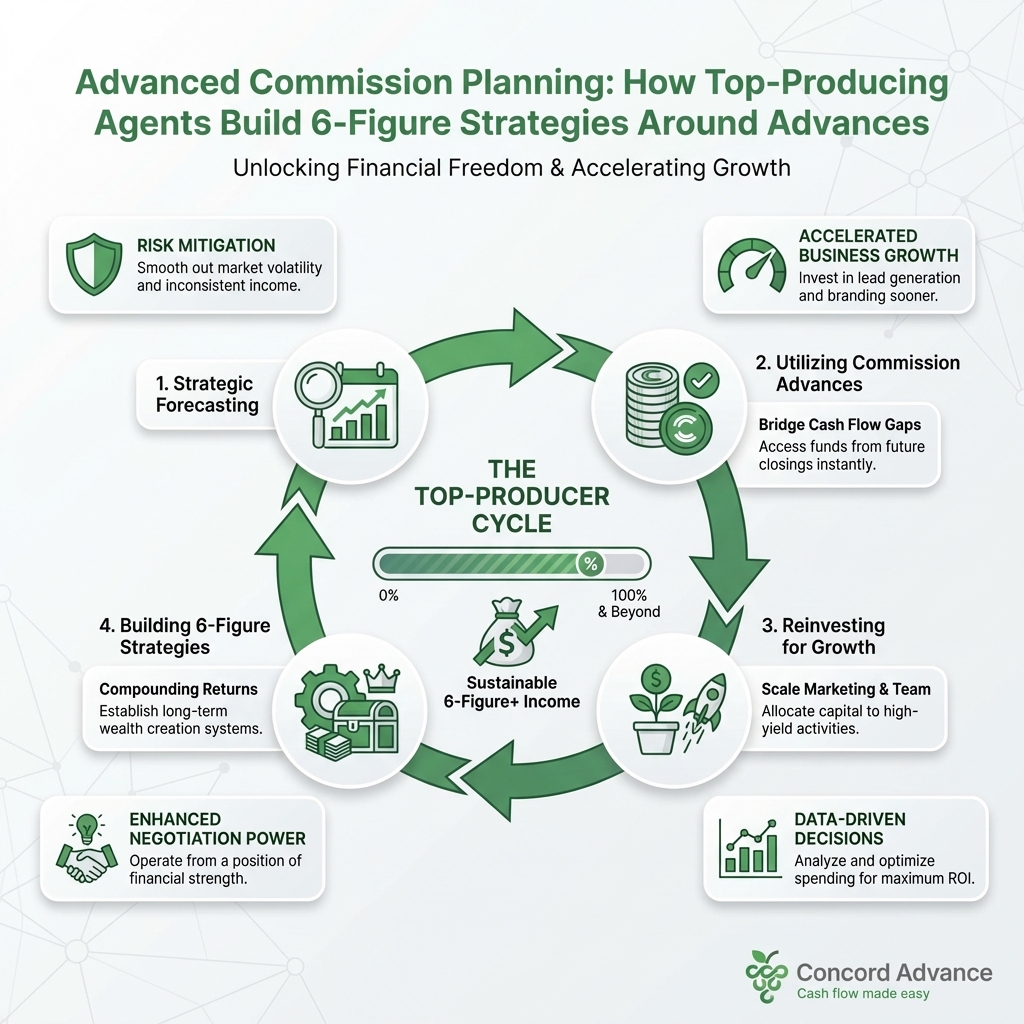
Advanced Commissions as a Six-Figure Strategy: How Top Producers Plan, Time, and Scale
In the world of top-producing real estate agents, the conversation around cash flow has evolved far beyond a simple quest for survival. Gone are the days when advanced commissions were just a lifeline for agents between closings. Today, the most successful professionals see them as sophisticated tools for deliberate, six-figure business building. Advanced commissions, when woven thoughtfully into a long-term financial strategy, empower high-achieving agents to maximize growth, stability, and profitability.
______________________________
Embracing the Power of Advanced Commissions
Before diving deep into commission advance planning strategy, it’s important to reframe the way we think about these financial products. For the mature, six-figure realtor, advanced commissions aren’t an emergency measure. Instead, they are part of a calculated approach to managing risk, scaling business operations, and achieving Gross Commission Income (GCI) objectives with agility.
Elite agents understand that cash does more than cover today’s bills. It accelerates tomorrow’s business opportunities. Used strategically, advances provide capital exactly when needed: enabling marketing pushes, rapid offer deployments, or team expansion, all while smoothing the peaks and valleys of real estate earnings.
______________________________
Making Advanced Commissions Part of Your Financial DNA
The first step in adopting a premium realtor financial strategy is to recognize advances as a legitimate and proactive lever in your business plan, not just an “in case of emergency” tool. How do teams and agents at the top of their game do this?
They integrate advances directly into their annual GCI planning, using it to forecast, budget, and fuel reinvestment at optimal moments. This proactive approach puts control back in the agent’s hands, rather than leaving cash flow at the mercy of a volatile closing calendar.
______________________________
Building a Commission Advance Planning Strategy
At the core of every high-performing agent’s financial blueprint lies a robust commission advance planning strategy. This approach weaves together prediction, timing, and resource allocation to ensure that advances power growth rather than patching shortfalls.
Forecasting Your GCI with Advance Options: Start with GCI planning that goes deeper than past transactions and market averages. Use advanced data tools, segmentation, and historic client behavior to project closings not just by month, but by likelihood and value.
From there, identify key moments where cash will produce the highest ROI. Is it preemptive marketing in a slow quarter? Funding staging for a luxury listing entering a hot market? Front-loading spring advertising? Each scenario is an opportunity where advances can be aligned with projected GCI peaks and valleys.
Agents who approach commission advance planning strategically may even model different scenarios: What would happen if I reinvested an advance in social ads this quarter? How would staggering two advances over summer allow for doubling up on prospecting investments ahead of the fall rush?
______________________________
Timing Strategies: The Art and Science of Advance Utilization
The difference between a reactive and a proactive realtor often comes down to timing. Rather than waiting until a cash crunch, advanced agents work from a detailed business calendar that integrates advance opportunities into their yearlong rhythm.
Key timing strategies include:
Aligning advances with seasonal market cycles. For example, leveraging advances to ramp up listing investment prior to busy periods, so that your marketing and client acquisition activities are never held hostage by delayed closings.
Utilizing advances to bridge strategic investments in team growth, allowing you to spend confidently on new hires or specialized contractors at the moment when growth is most needed, instead of waiting for unpredictable closings.
Synching advances with professional education, technology upgrades, or branding campaigns to ensure that downtime is an opportunity for development, not decline.
______________________________
Financial Laddering With Advances
A leading tactic among top-producing agents is the concept of laddering advances. Just like a seasoned investor might stagger bond maturities to guarantee liquidity at regular intervals, so too can agents “ladder” their advanced commissions according to a predictable, rolling plan.
This method involves setting a cadence of advances that coincides with known business needs and anticipated closing gaps, ensuring fresh capital is always available for reinvestment. Laddering prevents lump-sum dependency and cultivates an ongoing, sustainable cash flow strategy that matches your growth trajectory.
______________________________
Integrating Advanced Commissions Into an Annual Business Plan
Perhaps the most powerful way to leverage advanced commissions is to treat them as a recurring resource within your formal business plan. This holistic, year-in-advance approach is what separates advanced, high-performing agents from opportunistic or ad-hoc users.
Start by charting your entire expected year: map out predictable peaks (spring rush, Q4 investors) and valleys (slower summer or holiday periods). Overlay key business initiatives, new marketing campaigns, client appreciation events, technology investments, and team expansion phases, against this forecast.
With this master calendar in hand, schedule advances not as stopgaps but as drivers of impact. For example, you might decide to take an advance every March and September, timed to fuel a biannual marketing blitz or to underwrite pre-listing expenses for high-value properties.
The key here is intentionality. Advances are no longer last-minute lifeboats, but are part of a systemized, recurring strategy for business growth and fiscal health.
______________________________
Advanced Commissions: Shifting the Mindset
One distinguishing trait of top earners is their mindset. For the average agent, cash flow management is a scramble that competes with day-to-day sales activity. For high producers, financial strategy is built into operations, just like CRM pipelines or lead generation.
Advanced commissions, when planned, allow agents to:
Take calculated risks on expanded listings and client types, using fresh capital to enter untapped markets or test new marketing platforms
Attract and retain high-performing team members through timely payroll and resource commitments, even in between closings
Acquire best-in-class tech, staging, or marketing solutions without interruption, knowing that advances can buffer fluctuating income
Offer best-in-market client experiences, confidently fronting home prep, repairs, or concierge-like services that others can’t
______________________________
Unlocking Six-Figure Realtor Cash Flow
Transitioning to a six-figure realtor financial strategy demands professionalization at every level, and cash flow planning is no exception. An intentional approach to advanced commissions is especially powerful in a few key areas.
Growth Mode: When scaling your team, growing your listing volume, or entering luxury markets, your greatest constraint is often capital. Planned advances provide the working cash needed to hire admin support, launch elite marketing, and absorb higher up-front costs, without stalling while you wait for commissions to clear.
Income Smoothing: The reality of real estate is that income rarely arrives in a perfect monthly cadence. Even the busiest agents can have lean months interspersed with closing-heavy ones. Planned use of advances can normalize this, smoothing out your monthly income and allowing you to pay yourself and your team consistently, a hallmark of well-run businesses.
Controlled Reinvestment: Some of the most lucrative business opportunities, new lead sources, premium advertising, high-touch client events, require upfront investment. Rather than waiting for liquidity or tapping into lines of credit, advanced commissions enable high-ROI reinvestment on your schedule, not the market’s.
Reducing Stress, Increasing Focus: Perhaps one of the most underappreciated benefits is psychological. When advances are planned, not panicked, top agents spend less time worrying about cash and more time focusing on client relationships, negotiations, and business-building activities. Stability breeds creativity and excellence.
______________________________
Case Study: How an Elite Agent Wove Advances Into a Six-Figure Strategy
Consider the example of Sarah, a midwestern broker whose transaction volume climbed from $20 million to over $42 million in three years. Her secret wasn’t just grinding through more deals. It was transforming the way she planned and allocated cash flow throughout the year.
Sarah mapped her annual business plan, forecasting predictable income peaks around spring and autumn selling seasons. Rather than allowing summer’s typical slowdown to stall her growth, she scheduled commission advances in May and July, timing these boosts to fund pre-market home improvements and targeted digital ad campaigns. With advances incorporated into her annual rhythm, she built enough flexibility to launch a team expansion mid-year, secure in her ability to pay a new buyer’s agent and a transaction coordinator, even during lean months.
The result? More listings, increased team capacity, and the ability to seize high-ROI investments the moment they emerged. Sarah’s income smoothed out, her team’s morale soared, and her production doubled, all due to integrating advanced commissions from a position of strategic strength rather than need.
______________________________
Best Practices: Premium Thought Leadership on Commission Advance Planning
Agents who maximize advanced commissions focus on several best practices:
Plan advances at the annual and quarterly levels, tied to business milestones and not just “dry spells” or problem periods
Analyze ROI for all intended uses of advance funds, ensuring that every dollar accelerates growth, not just plugs a hole
“Ladder” advances to create a rolling calendar of liquidity, minimizing lump sum dependency and reducing stress around uncertain closings
Maintain transparency with your CPA or business coach to ensure advances fit within your tax, loan, and reinvestment frameworks
Reinvest in business-building activities that directly contribute to GCI: specialized marketing, lead generation platforms, luxury listing preparation, or client events
Organize your cash flow using a powerful CRM or financial dashboard, so scheduled advances always correspond with actionable business opportunities
Know your cost of capital. Evaluate the fee of the advance as you would any cost of business, not in isolation, but against the potential gains from earlier investments or growth moves
______________________________
The Future of Advanced Commissions: From Cash Flow Patch to Premium Growth Tool
As the real estate market grows ever more competitive, the need for agile, professional-grade financial planning is only becoming more urgent. Advanced commissions, once seen as bandages for the undercapitalized, have evolved into essential levers for high-growth agents.
Like any financial tool, their value depends entirely on strategy. It’s not about “needing” cash. It’s about putting cash to work for you, intentionally, within the framework of your annual goals, your GCI targets, and your pathway to market leadership.
______________________________
Conclusion: Trailblazing With Advanced Commissions
For those ready to advance well beyond the transactional mindset, the path is clear: Plan your business, schedule your advances, and let your capital lead your growth.
When advanced commissions become part of your proactive financial toolkit, you shift from reactive participant to the architect of your own success. You signal to your team, your clients, and yourself that you run a business, not a hustle. Your annual plan now has the flexibility and foresight needed to seize every opportunity, not just survive the valleys.
Whether your sights are set on doubling transactions, breaking into new markets, or becoming the go-to luxury team in your city, make advanced commissions the jet fuel for your next leap. Thoughtful, strategic, and data-driven use of advances can transform not just your cash flow, but your entire approach to growth, opening the door to the next level of real estate mastery. Plan ahead, invest wisely, and step into the circle of true top producers.