
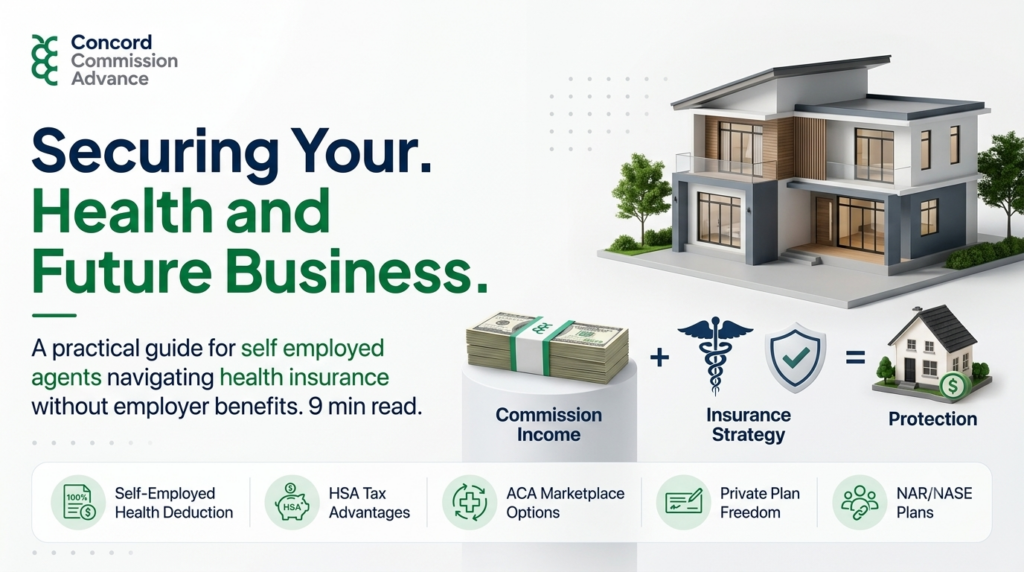
Most real estate agents are independent contractors. Coverage is entirely the agent’s responsibility, funded entirely from commission income, and in 2026 considerably more expensive than it was a year ago.
The enhanced ACA premium tax credits that reduced marketplace costs for millions of self-employed Americans expired on December 31, 2025. Agents who have not revisited their coverage strategy since 2025 are likely underbudgeted and possibly underinsured.
The options available to agents are strong, if they know where to look.
This guide is for informational purposes only. Agents should consult a licensed health insurance broker and CPA for guidance specific to their situation.
Key Takeaways
- Agents earning below approximately $60,240 annually may still qualify for ACA subsidies, making the marketplace the most cost-effective option at that income level despite the credit reduction.
- Agents above the subsidy threshold on good health should evaluate private PPO plans, which frequently produce lower effective premiums than unsubsidized marketplace Silver plans in 2026.
- The self-employed health insurance deduction allows agents to deduct 100% of premium costs from gross income, reducing both federal income tax and, indirectly, the self-employment tax base.
- An HSA paired with a qualifying high-deductible plan is one of the most tax-efficient vehicles available to self-employed agents, offering a triple tax advantage unavailable to most W-2 employees.
- NAR members have access to the Realtors Insurance Marketplace, and NASE membership provides access to group-rate plans through a separate channel worth comparing against individual market pricing.
What Changed in 2026 and Why It Matters
The enhanced premium tax credits under the American Rescue Plan ran from 2021 through 2025 and significantly lowered marketplace costs for self-employed buyers. Their expiration produced a specific and tangible impact:
- Average net monthly premiums for agents who previously received credits rose from $113 to $178. A 58% increase even with remaining subsidies
- Unsubsidized Silver plan premiums for a 40-year-old now average $741 per month nationally
- Average marketplace deductibles rose to $3,786, meaning most plans do not begin covering costs until that amount has been spent out of pocket
An agent whose income crosses the threshold from subsidized to unsubsidized faces a significant jump in premium cost. For agents near that threshold, income timing decisions like when commissions are recognized, or whether an S-Corp election is in place, can determine which side of the cliff they land on.
The Options, Explained
ACA Marketplace (healthcare.gov or State Exchange)
Marketplace plans are guaranteed issue. Pre-existing conditions cannot affect eligibility or pricing. This is their primary structural advantage over private plans.
Who benefits most: Agents with pre-existing conditions, at any income level. Agents with income below approximately $60,240 who qualify for remaining premium tax credits. Agents who have recently lost employer coverage and need to enroll outside the standard November to January window through a Special Enrollment Period.
The income estimation problem agents frequently get wrong: Marketplace subsidies are based on estimated annual income, reconciled at tax filing. Commission income is variable. An agent who estimates $70,000, earns $95,000, and received a subsidy based on the lower figure owes the difference at filing. Updating the income estimate at healthcare.gov mid-year when a strong closing period materially changes the projection, helps avoid a significant year-end tax surprise. This is one of the most common and most avoidable financial mistakes self-employed agents make with marketplace coverage.
Metal tier selection: Bronze plans carry the lowest premiums but the highest deductibles. In many cases exceeding $7,000 before coverage begins. An agent who chooses Bronze and then has a significant health event pays far more out of pocket than the monthly premium savings justified. Gold plans cost more monthly but have meaningfully lower deductibles and out-of-pocket maximums. The right tier depends on anticipated healthcare use. An agent who expects to use coverage regularly is frequently better served by a higher-premium, lower-deductible plan.
Private Health Insurance (Non-ACA Plans)
Private PPO plans (underwritten, not ACA-compliant) are available year-round and frequently produce lower monthly premiums than unsubsidized marketplace plans for agents who are in good health. Costs range from $190 to $450 per month depending on age, state, and coverage selected.
What most agents do not know: These plans can begin coverage within days of application and there is no open enrollment window. An agent who misses the marketplace enrollment period, changes situations mid-year, or simply wants to compare pricing has access to private plans at any time.
The important trade-off: Private plans are medically underwritten. Carriers can ask health questions, exclude pre-existing conditions for a defined period, or decline coverage entirely based on health history. Agents with chronic conditions or ongoing medical needs are better served by the marketplace’s guaranteed-issue guarantee.
NAR Realtors Insurance Marketplace and NASE
NAR members have access to the Realtors Insurance Marketplace, which is a private exchange offering ACA-compliant health, dental, and vision options at negotiated rates. It is not employer-sponsored group coverage but provides a curated comparison point worth checking before purchasing from the public marketplace.
NASE (the National Association for the Self-Employed) offers access to group-rate health plans through USHEALTH Group, MetLife, and Assurant for members. Annual NASE membership is modest relative to potential premium savings, and the plans are worth comparing directly against marketplace and private plan quotes for the same coverage level.
Keller Williams operates its own KW Wellness Benefits Marketplace for affiliated agents. Agents at major franchise brokerages should confirm whether a comparable program exists before purchasing coverage elsewhere.
Spouse or Domestic Partner’s Employer Plan
For agents with a spouse or partner carrying employer-sponsored coverage, joining that plan is typically the simplest and most cost-effective option available. The employer’s contribution toward the premium reduces the household cost significantly compared to individual market rates.
A tax detail most agents miss: Months during which an agent is eligible for a spouse’s employer plan disqualify the self-employed health insurance deduction for those months. If the employer plan covers only the spouse and the agent purchases individual coverage separately, the deduction remains available for the agent’s own premium. A CPA should confirm the specific treatment based on the plan’s structure.
Short-Term Plans and Health Sharing Ministries
Short-term plans provide temporary coverage at lower premiums, typically for gaps between enrollment periods rather than as primary long-term coverage. They are underwritten, exclude pre-existing conditions, and commonly omit mental health and maternity coverage.
Health sharing ministries are not insurance. Members share each other’s healthcare costs according to defined guidelines. Monthly contributions are lower than most insurance premiums, but coverage is not guaranteed and the consumer protections that apply to licensed carriers do not apply. For healthy agents comfortable with that risk profile, they represent a lower-cost alternative.
The Tax Advantages Worth Maximizing
The Self-Employed Health Insurance Deduction
100% of health insurance premiums paid by a self-employed agent are deductible from gross income as an adjustment (not an itemized deduction) on Schedule 1 of Form 1040 (Form 7206).
This carries two benefits that agents frequently underestimate. First, it reduces federal income tax. Second, because it reduces adjusted gross income, it lowers the MAGI figure used to calculate ACA subsidy eligibility, meaning an agent near the subsidy threshold may qualify for credits that their gross income figure suggested they would not.
The deduction is available only in months during which the agent was not eligible for an employer-sponsored plan, including a spouse’s employer plan.
Health Savings Accounts
An HSA is available to agents enrolled in a qualifying high-deductible health plan. The triple tax advantage of contributions deductible, growth tax-free, qualified withdrawals tax-free, is not available through any other savings vehicle.
2025 contribution limits: $4,300 for individual coverage, $8,550 for family coverage, with a $1,000 catch-up for agents 55 and older.
HSA balances roll over year to year. An agent who contributes consistently and remains healthy accumulates a balance that functions as a dedicated healthcare reserve with usable tax-free for medical expenses in any future year, including retirement. At retirement age, HSA funds can be withdrawn for any purpose without penalty, functioning similarly to a Traditional IRA.
For agents who are generally healthy, the combination of lower HDHP premiums and HSA contributions frequently produces a lower total annual healthcare cost than a lower-deductible plan at a higher monthly premium, particularly when the HSA tax savings are factored in.
Summary
| Option | Best For | 2026 Monthly Cost (est.) | Pre-Existing Conditions Covered | Deductible Range |
| ACA Marketplace (subsidized) | Agents below ~$60,240 income | Below market with credits | Yes | 1,500–7,000+ |
| ACA Marketplace (unsubsidized) | Agents with pre-existing conditions above threshold | ~$741 (Silver, age 40) | Yes | $3,786 avg |
| Private PPO plan | Healthy agents above subsidy threshold | 190–450 | Varies by underwriting | Varies |
| NAR / NASE association plans | NAR members; NASE members | Varies: compare directly | Yes (ACA-compliant) | Varies |
| Spouse’s employer plan | Married agents with working spouse | Employer-subsidized | Yes | Per employer plan |
| Short-term plan | Gap coverage only | Lower than ACA | No | High |
| HDHP with HSA | Healthy agents wanting tax efficiency | Lower than standard plans | Yes | $1,600+ individual |
How to Budget for Health Insurance on Commission Income
Health insurance premiums arrive monthly regardless of whether a commission does. They belong in the fixed expense column alongside MLS dues and E&O insurance and not in variable spending that scales with income.
A practical approach: calculate the full annual cost of premiums plus a realistic estimate of out-of-pocket costs based on anticipated healthcare use. Divide by 12. Fund that monthly figure from commissions as they arrive and hold it separately. The agent who treats health insurance as a fixed business cost weathers slow months without coverage gaps.
Common Questions
Can an agent deduct premiums if they have formed an LLC?
A single-member LLC is treated as a sole proprietorship for tax purposes — the deduction applies the same way. An S-Corp election changes the treatment and premiums should be handled through payroll. A CPA should confirm the correct approach.
What happens if income changes significantly mid-year and the agent is on a subsidized marketplace plan?
Updating the income estimate at healthcare.gov when income changes meaningfully prevents a large repayment at filing. The marketplace allows updates at any time during the year.
Is COBRA worth considering?
COBRA continuation from a prior employer is available for up to 18 months. The agent pays the full premium, employee and employer portions combined, making it typically the most expensive individual coverage available. It is most useful as a short-term bridge to the next ACA enrollment window rather than a long-term solution.
The Bottom Line
Health insurance options are available, the tax deductions are significant, and the HSA is one of the most underused financial tools in the self-employed agent’s toolkit. The right choice in 2026 depends on income level, health history, and whether the agent is above or below the ACA subsidy threshold. These three variables that determine both the best option and its effective cost after tax deductions are applied.
Agents managing large fixed expenses between commissions can access pending income early through Concord Advance, at a rate based on time to closing. Full pricing at concordadvance.com/rates-page.

