
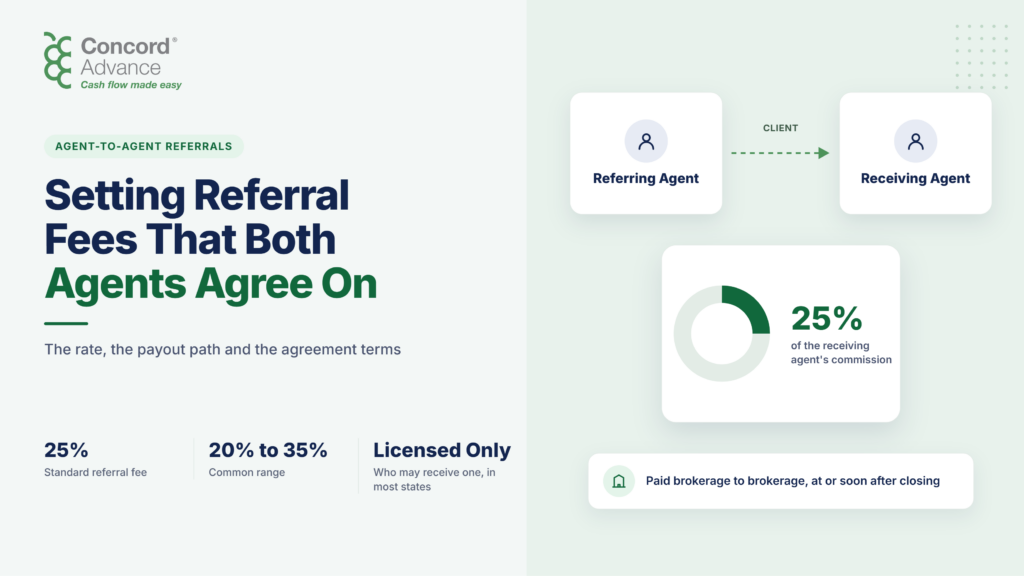
A real estate referral fee is the share of a commission paid to a licensed agent or broker for introducing a client to another agent who then closes the transaction. It comes out of the commission and adds no cost for the client.
The conventional rate is 25% of the receiving agent’s gross commission, within a common range of 20% to 35%. No state licensing law or NAR rule fixes that percentage, so the number, the amount it is calculated on, and how long the right to it lasts are all set by the agreement between the two agents.
This guide covers how to set the percentage, how the fee moves through a closing, who may receive one, and the clauses a referral agreement benefits from containing.
Key Takeaways
- The standard referral fee is 25% of the receiving agent’s gross commission.
- The fee is typically calculated on the commission the receiving brokerage actually receives, so a negotiated reduction in buyer agent compensation lowers the fee too.
- Payment moves from the receiving brokerage to the referring agent’s brokerage, and the referring agent is paid through their own brokerage under their own split.
- Whether the fee comes off before or after the receiving agent’s brokerage split changes the receiving agent’s net by hundreds of dollars on an ordinary transaction.
- In most states only licensed agents and brokers may receive a referral fee, and RESPA Section 8 restricts payments for referring clients to lenders, title companies, and other settlement services.
- A written agreement signed before the client is introduced should state the percentage, the base it applies to, the payment timing, and the length of the tail.
How Much Is a Real Estate Referral Fee?
Twenty-five percent is the default most agreements start from. Where a specific referral lands in the 20% to 35% range depends on what the referring agent delivers.
| Referral type | Typical fee |
| Warm referral from a past client or close contact, pre-approved and ready to transact | 30% to 35% |
| Full handoff with timeline, budget, and financing status already established | 25% to 30% |
| Introduction to a prospect who needs significant nurturing | 20% to 25% |
These bands reflect common practice and remain negotiable. Setting the percentage before the introduction is easier than raising it after the receiving agent has started working with the client.
Referral platforms publish their own schedules, commonly 25% to 40% of the receiving agent’s commission, and some specify a tail of up to two years. Agents who accept leads through a platform agree to those terms at enrollment, so the negotiation happens once, which is when the agent joins.
How the Fee Is Calculated
The fee is quoted as a percentage of the receiving agent’s side of the commission, and the sale price is not part of the calculation. On a $500,000 sale with a 2.5% buyer agent commission, the gross commission is $12,500 and a 25% referral fee is $3,125.
What the receiving agent keeps depends on where the fee sits relative to the brokerage split. Using a 70/30 split:
| Treatment | Receiving agent’s net |
| Fee deducted before the split | $6,562.50 |
| Fee deducted after the split | $5,625.00 |
The $937.50 difference on a single transaction comes from one clause in the agent’s brokerage agreement. Because the fee is paid by the receiving brokerage, many arrangements deduct it from the gross commission before the split, but brokerages differ. Confirming the treatment before accepting a referral gives an accurate net figure from the start.
How Referral Fees Are Paid at Closing
Referral fees move between brokerages, and agents are not paid directly by each other.
- The receiving agent’s brokerage receives the commission from the closing agent.
- The referral fee is paid from that commission to the referring agent’s brokerage. It appears as a named payee on the Commission Disbursement Authorization, and the agreement sets whether payment happens at closing or within a stated number of days after the brokerage receives funds.
- The referring agent’s brokerage pays the referring agent per their compensation agreement.
The third step means the referring agent’s share is also subject to their own split. A $3,125 referral fee paid to a brokerage on a 70/30 split reaches the referring agent as $2,187.50.
Who Can Legally Receive a Referral Fee
Licensed agents and brokers. In most states, only licensed real estate professionals may receive a referral fee. Cash payments to unlicensed individuals, including past clients, are prohibited under most state commission rules. Thank-you gifts to clients fall under separate state rules and RESPA’s definition of a thing of value.
Out-of-state agents. Agents licensed in their own state commonly refer clients to agents in other states. The receiving agent’s state commission governs what can be paid, so confirming that rule before the introduction avoids a compliance issue.
RESPA Section 8. Section 8 prohibits fees or kickbacks for referring settlement service business tied to a federally related mortgage loan. An agent cannot receive payment for steering a client to a lender, title company, or similar provider. Referral fees between licensed brokers for brokerage business are a separate category and are generally permitted.
Client disclosure. State rules and brokerage policy often require that clients be told about a referral fee arrangement. The agreement is the natural place to document that disclosure was made.
What a Referral Agreement Should Say
A one-page agreement signed by both agents and acknowledged by both brokers settles almost every dispute in advance. The clauses that matter most:
- Parties and brokerages. Full legal names, license numbers, and the brokerage of each agent.
- The client and the transaction. Client name, whether the referral is for a buyer or seller, and the geography or price range.
- Percentage and base. The fee percentage and the amount it applies to, stated as the commission the receiving brokerage actually receives on that side, before or after deductions.
- Payment mechanics. Which brokerage pays which, and the deadline after closing or receipt of funds.
- The tail. The period during which a closing triggers the fee, and whether it covers a different property purchased by the same client. Agent-to-agent tails are set by agreement, and platform programs sometimes extend them to two years.
- No closing, no fee. The fee is owed only when a commission is received.
- Client status. The referring agent confirms the client is not under an exclusive agreement with another agent.
- Client disclosure. A statement that the client was told of the arrangement where state rules or brokerage policy require it.
- Governing law and disputes. The state whose law applies and the dispute path, which is often association arbitration.
- Signatures. Both agents and both brokers.
Scenarios the Agreement Should Anticipate
- The first deal falls through and the client buys a different property. The tail clause decides whether the fee follows the client.
- The commission is reduced after contract. A base tied to commission actually received adjusts the fee automatically.
- The receiving agent moves brokerages before closing. The obligation travels with the transaction, and the agreement can require notice to the referring brokerage.
- The receiving agent represents both sides. The agreement states whether the fee applies to one side or both.
Enforceability of oral referral agreements varies by state, and the terms are difficult to prove after the fact. Writing it down before the introduction protects both agents.
Referral Fees From the Receiving Agent’s Side
For the agent receiving the referral, the fee is owed only if the transaction closes, which makes it a contingent cost. Paid lead sources charge for leads whether or not they convert.
How referral costs compare with paid lead channels is covered in Zillow vs. Google vs. Facebook vs. Referrals: Where Real Estate Agents Get the Best Return on Lead Spend in 2026.
The fee also reduces the net commission, which is the figure a commission advance is sized against. An agent with a referral fee owed on a pending transaction gets the most accurate advance estimate by calculating net commission after the fee.
Referral Fee at a Glance
| Item | Typical practice |
| Standard percentage | 25% |
| Common range | 20% to 35% |
| Calculated on | Receiving agent’s gross commission received |
| Paid by | Receiving agent’s brokerage |
| Paid to | Referring agent’s brokerage |
| Timing | At closing or within days of receipt, per agreement |
| Who may receive | Licensed agents and brokers in most states |
| Tail period | Set by agreement |
Common Questions
Is a referral fee negotiable?
Yes. No state or NAR rule sets the percentage, and 25% is a convention.
Is the fee owed if the referred client buys a different property?
The tail clause decides. An agreement that is silent on this point leaves it open to dispute.
How is a referral fee reported for taxes?
The referring agent typically receives it as part of commission income through their own brokerage. A CPA can confirm the treatment for a specific situation.
How commission income and deductions are reported for independent contractor agents is covered in Commission Advances and Taxes: What Real Estate Agents Need to Know.
Can a referral fee be paid to a past client?
In most states cash referral fees can be paid only to licensed professionals. Gifts to clients are governed by separate state rules.
The Bottom Line
A referral fee is a negotiated percentage of a commission, paid brokerage to brokerage, and the details around that percentage decide how much each agent keeps. The base it applies to, its position relative to the brokerage split, the payment timing, and the length of the tail each change the outcome by hundreds or thousands of dollars on a single closing.
A one-page written agreement signed before the introduction sets all of them in advance.
Agents with a referral fee owed on a pending transaction can calculate the net commission after that fee before applying for an advance. Concord Advance sizes advances against that net figure, at a rate based on time to closing. Full pricing at concordadvance.com/rates-page.

