

A business line of credit made sense when it was the most practical tool available. For many high-producing real estate agents, it was the default answer to an uneven closing calendar.
The problem is not that a line of credit stops working. It is that agents who examine what it actually costs them: in interest, credit utilization, and personal liability, find that it is solving a problem that has a more direct solution.
Key Takeaways
- A business line of credit is revolving debt. Every dollar drawn is a liability on the agent’s credit report until it is repaid.
- Interest on a business LOC compounds on the outstanding balance, the longer it is carried, the more it costs.
- High-producing agents are more exposed to LOC costs than lower-volume agents because they draw larger amounts and carry balances across more transactions simultaneously.
- A commission advance accesses money already earned on a specific pending transaction. It creates no debt, triggers no credit inquiry, and does not affect the agent’s debt-to-income ratio.
- The agents reconsidering their LOC in 2026 are typically not cash-flow constrained. They are cost-aware and looking for a cleaner instrument.
What a Business Line of Credit Actually Costs
A business LOC is not free money between draws. The true cost has several components that compound over time, particularly for agents carrying a balance across multiple active transactions.
Interest rate. Business LOC rates in 2026 vary considerably by lender, credit profile, and whether the line is secured or unsecured. Rates for unsecured business lines commonly range from 8% to 25% annually. On a $30,000 draw carried for 60 days, even an 8% rate produces approximately $400 in interest, a figure that scales with the balance and the carry period.
Draw fees. Some lenders charge a fee each time the line is accessed, separate from the interest rate. These are easy to overlook and add to the effective cost of each draw.
Annual maintenance fees. Most business LOCs carry an annual fee simply for keeping the line open, regardless of whether it is used. For agents who access the line infrequently, this fee represents a fixed overhead cost on a tool that may not be earning its keep.
Personal guarantee. The majority of business lines of credit, particularly for self-employed borrowers, require a personal guarantee. This means the agent, and their firm, is liable for the outstanding balance. In the event of default, personal assets are at risk.
Credit utilization impact. Drawing on a business LOC increases credit utilization. For agents who are also managing a personal mortgage, financing a vehicle, or planning any credit-dependent transaction, a high utilization rate on a business line can reduce personal credit scores at exactly the moment the agent least wants that to happen.
How High-Producing Agents Actually Use Their LOC
For most high-producing agents, the line of credit is not used for emergencies. It is used to bridge the gap between active business expenses and commission income, the exact problem a commission advance is designed to solve.
The pattern tends to look like this: the agent has two or three deals under contract, all closing within 45 to 90 days. Operating expenses continue in the meantime, marketing for new listings, brokerage fees, and personal overhead. The agent draws on the LOC to cover those costs and repays it when commissions arrive.
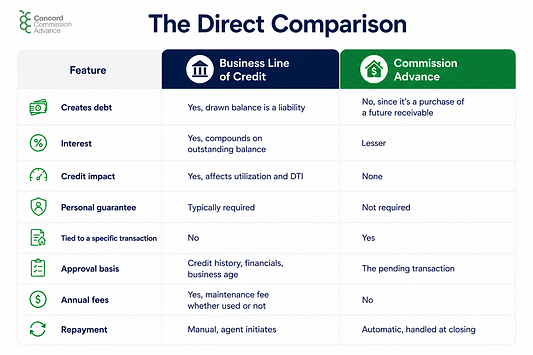
This is a functional approach. It is also one where the agent is paying interest on money they have already earned on commissions that exist in a signed contract and are waiting for a closing date. The LOC is financing a gap that could be closed more directly.
What Changes When Agents Use Both Deliberately
The agents who restructure their approach typically land on something like this:
- Commission advance for bridging gaps tied to specific pending transactions. It’s faster and cheaper on the advance amount, and leaves the LOC untouched
- Business LOC for capital needs that are not tied to a pending deal.
The result is that the LOC balance stays lower, interest costs drop, credit utilization improves, and the personal guarantee exposure is reduced. The LOC does not disappear from the agent’s financial toolkit, it just stops being the default answer to every cash flow question.
Why This Shift Is Happening in 2026 Specifically
Three factors are accelerating the reassessment among high-producing agents this year.
Interest rates remain elevated. Business LOC rates have not returned to the historically low levels of 2020 and 2021. Agents who established lines during that period and used them casually are now carrying balances at meaningfully higher rates than they originally modeled.
Commission structures are in transition. Post-NAR settlement, the certainty of buyer agent compensation on any given transaction is lower than it was two years ago. Agents who previously relied on predictable commission income to service LOC draws are now managing more variability in what each deal pays, making a transaction-specific tool more appealing than open-ended revolving debt.
Larger advances are now available. The commission advance industry has matured. Advances on larger commissions, $20,000, $30,000, and above, are more accessible than they were five years ago, covering a meaningful portion of the gap that agents previously turned to their LOC to fill.
When a Commission Advance May Not Be the Right Choice
Very short closing timelines. On a deal closing in 10 to 15 days, a low-rate LOC may cost less in interest than the advance fee. Agents who have both tools available benefit from running the numbers on the specific timeline before deciding.
Agents with very low LOC rates. An agent carrying a secured LOC at 6% or below and closing within 30 days may find the LOC is the lower-cost option on that specific draw. The advance becomes more competitive as the timeline extends and as credit considerations become more relevant.
Deals with meaningful fall-through risk. If a transaction is at an early or uncertain stage with contingencies unresolved, or financing not yet confirmed, the advance fee applies regardless of outcome. Most advance companies, including Concord Advance, work with the agent to recover the amount from the next closed transaction rather than requiring immediate repayment. That said, agents benefit from evaluating the strength of a transaction before advancing on it.
Common Questions
If an agent already has a LOC, is there any reason not to use a commission advance instead for transaction-specific gaps?
The primary consideration is cost. For an agent whose LOC rate is below the commission advance fee on a short timeline, say, a deal closing in 15 days, the LOC may cost less. For deals closing in 45 to 90 days, the math typically favors the advance. Agents benefit from running both numbers before deciding.
Does using a commission advance affect LOC eligibility?
No. A commission advance creates no debt and triggers no credit inquiry. It does not appear on a credit report and has no effect on the agent’s ability to maintain or draw on an existing line of credit.
Can an agent use a commission advance and a LOC on the same transaction?
Technically yes, though the advance is typically sized as a portion of the pending commission, meaning the agent is not advancing the full amount anyway. Whether both are needed simultaneously on a single transaction is a matter of how large the gap is relative to the advance available.
What happens to the LOC balance if an agent shifts to using commission advances for transaction gaps?
The balance decreases because the agent is drawing less frequently. Lower utilization improves credit standing, reduces interest expense, and reduces the effective risk under the personal guarantee.
The Bottom Line
A business line of credit is a legitimate and useful financial tool. For high-producing agents using it primarily to bridge gaps between signed contracts and commission disbursements, it is also a more expensive and credit-intensive instrument than the alternative. The agents reconsidering it in 2026 are doing so because they have run the numbers and found that a commission advance is a more direct solution to the specific problem they have been using their LOC to solve.
The LOC does not go away. It gets used for what it is actually designed for.
Concord Advance provides commission advances to real estate agents and brokers nationwide, with no credit impact and automatic repayment at closing. Full pricing is available at Commission Advance Rates.

