
February 11th, 2026
Understanding Net Payouts With a Concord Commission Advance: A Comprehensive Guide for Real Estate Agents
In the fast-paced world of real estate, agents often face the challenge of managing irregular income streams. Commission checks can take weeks or even months to close, making it difficult to cover essential business expenses or invest in marketing strategies that drive growth. Enter the commission advance: a financial tool that is changing the game for agents who seek cash flow certainty. Among the reputable providers in the industry, Concord Commission Advance stands out for its transparent process and agent-friendly terms.
If you’re considering a commission advance or simply want to better understand the net payout when using a service like Concord, this comprehensive guide is for you. We’ll unravel how the commission advance process works, break down net payout calculations, dive into commission advance agreements, and provide insights to ensure you make the most informed decisions for your real estate business.
What Is a Commission Advance?
A commission advance is a financial arrangement that allows real estate agents to access a portion of their earned commission before the actual closing of a property deal. Rather than waiting weeks for escrow to close and payments to disburse, agents can receive immediate funds, alleviating cash flow challenges and empowering them to invest further in their business.
How does this work? An advance provider such as Concord reviews your pending deals, analyzes the likelihood of their successful closing, and offers to front you a percentage of your earned commission for a fee. When the transaction finalizes, the advanced amount plus the agreed-upon fee is repaid directly from your commission check.
The Role of Concord Commission Advance
Concord Commission Advance has established itself as a trusted provider in the real estate industry by prioritizing clarity, efficiency, and agent-focused terms. Concord’s processes are designed for maximum transparency, offering user-friendly commission advance agreements and clear net payout calculations. But to truly maximize the benefits of a commission advance, agents must grasp the nuances of how fees and splits impact their final net payout.
Understanding Net Payout With a Concord Commission Advance
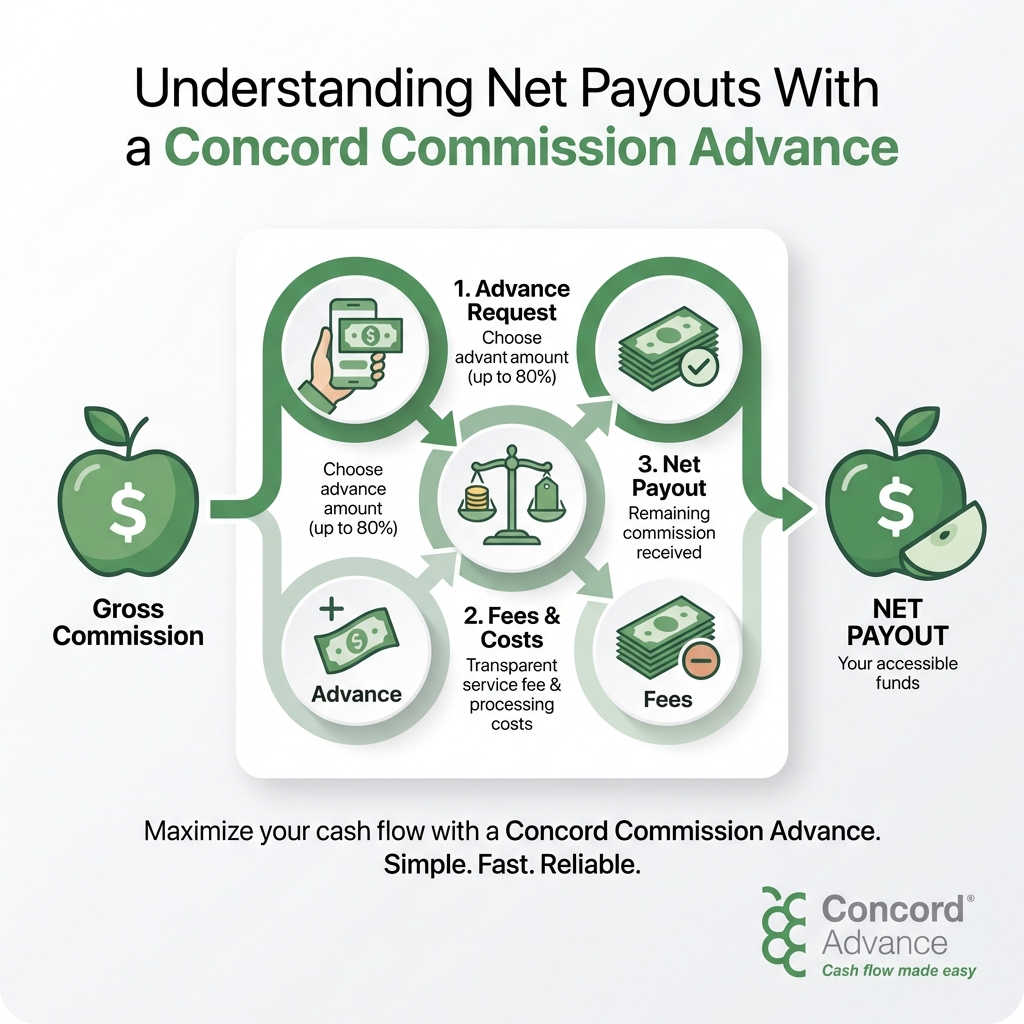
Your “net payout” reflects the actual amount you receive from a commission after considering advance fees, brokerage splits, transaction expenses, and any other deductions. Let’s break down how your net payout is calculated when working with Concord, using sample numbers and detailed explanations.
The Basic Net Payout Formula
To begin, it’s essential to understand the constituents of a typical real estate commission transaction:
Gross Commission: The total amount paid upon the sale of a property, usually calculated as a percentage of the sales price.
Brokerage Split: The portion of the commission your brokerage retains. Broker commission splits can vary widely—in some cases, 70/30 or 80/20 splits are common, where the agent keeps 70 or 80 percent.
Franchise/Transaction Fees: Some brokerages or franchises may charge additional administrative or transaction fees.
Advance Amount: The portion of your future commission Concord advances to you, typically capped at a percentage of your share (often up to 90%).
Advance Fee: The cost of accessing your commission early. With Concord, fees are transparent and competitive.
Your Net Payout can then be represented as:
- – Net Payout = (Gross Commission – Brokerage Split – Fees) – Concord Advance Fee
- – Let’s walk through a concrete example for clarity.
Sample Net Payout Calculation
Suppose you close a $500,000 home sale with a 3 percent commission rate. Here’s a typical breakdown:
- – Gross Commission: $15,000 (3 percent of $500,000)
- – Brokerage Split: 80/20, so your gross share is $12,000
No franchise or transaction fees for simplicity
You apply for a Concord commission advance on your $12,000 share. Concord approves an advance of $10,000. Their fee for a 30-day advance is $350 (for illustrative purposes).
Here’s what happens:
- – Total Available Commission: $12,000
- – Concord Advances To You: $10,000
- – Concord’s Advance Fee: $350
At closing, the settlement office pays Concord $10,350 from your share. The remainder ($1,650 = $12,000 – $10,350) is released to you.
If you had not taken an advance, you would have received the full $12,000 at closing. With the advance, you received $10,000 up-front. After the transaction closes, you receive an additional $1,650 (the remainder). In total, you’ve paid $350 for early access to your funds.
But what if your commission includes transaction fees, or you only choose to advance a smaller portion? The net payout logic remains the same: deduct all relevant fees and splits from your gross commission, subtract any advance fees, and what’s left is your net payout.
Commission Splits and Their Impact on Net Payout
One of the critical variables that affect your net payout is the commission split you have with your brokerage. These splits are part of your agreement with your real estate company and can range from highly agent-favored (like 100-percent commission models with monthly desk fees) to more traditional splits where the brokerage keeps a percentage.
Why does this matter for a commission advance? Concord and similar companies only advance cash based on your net commission after splits and fees. That means:
If you have a 70/30 split, you only qualify for an advance on your 70 percent share.
If your brokerage deducts $500 per transaction, the advance calculation is made after reducing this fee from your share.
Typical splits and fees agents should factor in:
- – Standard Brokerage Split (e.g., 80/20, 70/30)
- – Transaction/Admin Fees (such as $300 per deal)
- – Franchise Fees (often around 5-7 percent of gross commission)
- – Desk or Monthly Fees (usually paid separately, not tied to a single deal)
- – Local Board or MLS Fees (generally not deducted from commissions, but relevant to your bottom line)
When reviewing your commission advance agreement with Concord, double-check that all these fees are clear and that you understand exactly what portion of your commission is eligible for an advance.
How Concord Commission Advance Structures Repayment
A common concern among agents is how repayment works, and what happens if a deal falls through. Concord’s process is straightforward:
- – Once your deal closes, the closing attorney or title company sends Concord the advanced portion plus their fee directly from the commission check.
- – If for some reason the sale fails to close, Concord typically works with you to apply the repayment to a different pending transaction or to reschedule repayment terms, taking the pressure off the agent.
It’s essential to carefully review your commission advance agreement, as this document will outline the terms, fees, and contingencies in detail.
Breaking Down the Commission Advance Agreement
The commission advance agreement with Concord (or any similar provider) is a binding document governing the terms of your advance. Understanding the details of this agreement is crucial to protecting your financial interests and maximizing your net payout.
Key Elements to Review in Your Agreement:
Advance Amount: The specific dollar figure Concord is fronting you, and how it relates to your pending commission.
Fee Schedule: The exact fee charged for the advance, either as a fixed amount, a percentage of the advanced sum, or both. Some companies have variable fees depending on how long the advance is outstanding.
Repayment Terms: Details on how and when payment is due (typically upon closing).
What Happens If the Deal Falls Through: Policies about failed transactions, substitution of another pending deal, or repayment schedule.
Other Deductions: Whether franchise or administrative fees are factored before or after the advance.
Agent/Broker Authorization: Permission for Concord to collect payment directly from the closing settlement.
It is in your best interest to keep a copy of your agreement and to go over it with your broker or legal counsel if you have any questions.
Timing and Advance Fees: What to Expect
A common question is how much you’ll pay for a commission advance and how quickly you can get your money. Here’s what you should know about Concord’s process:
Speed: Concord is known for rapid approvals—often within the same day after submitting your application and supporting documents. Funds can appear in your account as soon as the next business day.
Fee Structure: Advance fees are typically spelled out in the agreement and are determined by the advance amount and expected repayment period. For example, a 30-day advance on $10,000 may incur a flat dollar fee or a small percentage of the amount advanced.
Multiple Advances: If you’re a top producer juggling several pending deals, you can often request multiple advances—as long as each is tied to a specific, eligible contract.
Transparency: Concord prides itself on telling you exactly what you’ll pay, with no hidden fees or complicated schedules.
If your deal is expected to close quickly, the cost of an advance may be very low relative to the value of immediate cash flow. Concord allows you to review these calculations before you commit.
How to Maximize Your Net Payout When Using a Concord Commission Advance
To make the most of your advance and keep your net payout as high as possible, smart financial strategies are essential. Consider these steps:
Advance Only What You Need: Concord will advance up to a capped portion of your net commission. Only draw what’s necessary for essential expenses or high-ROI investments. Less advanced means less in advance fees, which ups your net payout.
Understand Every Deduction: Double-check not only the Concord advance fee, but also franchise fees, desk fees, and any other recurring deductions that may impact your eligible commission.
Monitor Deal Status Closely: Since repayment hinges on your deal closing, work closely with transaction coordinators, lenders, and title companies to reduce the risk of delays or fallout.
Compare Providers if Needed: While Concord is highly rated, every provider has different fee structures. It pays to shop around, especially if you’re making commission advances a regular part of your cash flow management.
Work With Your Broker: Some brokerages may have preferred relationships with Concord or other providers, unlocking better terms or faster approvals.
Plan for Taxes: Commission advances are not additional income; they’re simply early access to your earnings. Keep careful records for tax purposes, so you’re not caught off guard when it’s time to file.
The Ideal Candidate for a Commission Advance
While commission advances can be helpful for agents of all experience levels, they’re especially useful in certain situations:
New Agents: Building a pipeline takes time. An advance can help new agents invest in marketing, open houses, and leads before their first big check arrives.
Busy Top Producers: When juggling multiple deals with staggered close dates, advances make it easier to smooth out cash flow and seize time-sensitive opportunities.
Agents Facing Unexpected Expenses: Whether it’s a last-minute repair, travel, or a tech upgrade, advances help bridge the gap without resorting to high-interest debt.
Agents Moving Brokerages: A commission advance can make the transition to a new brokerage smoother by easing temporary cash crunches.
That said, commission advances are just one of many financial tools available. Use them strategically and thoughtfully to support your business, not to cover unchecked spending or recurring deficits.
Common Misconceptions About Commission Advances and Net Payouts
Let’s clear up a few misunderstandings that real estate agents sometimes have about commission advances and how they impact final earnings:
It’s Not a Loan: A commission advance is secured against a specific, pending commission payment. There’s typically no impact on your credit score, and there’s no long-term debt.
Fees Are Not Excessive: When compared to credit cards or personal loans, a commission advance fee is often competitive—especially for short-term needs.
You Still Get a Payout at Closing: Some agents fear that their entire commission disappears with an advance. Not so; you receive the agreed-upon share up-front, then are paid the remainder (minus the fee) after closing.
It Doesn’t “Reduce” Your Commission: The only reduction comes in the form of the clearly disclosed fee. You’re not giving up extra points or additional shares of your earnings.
There’s No Obligation to Use Advances: You can use commission advances as needed, when cash flow demands, and decline them on deals where you prefer to wait.
Navigating the Application Process With Concord
One of the reasons Concord Commission Advance is so popular among real estate professionals is its simplicity. Here is a typical roadmap from application to funding:
Gather Documentation: You’ll need your pending sales contract, commission breakdown, ID, and broker approval.
Apply Online: Concord’s online platform streamlines the process and provides a quick decision.
Review and Sign Agreement: Carefully evaluate the advance amount, fee, and terms. If it looks good, e-sign to accept.
Receive Funds: In many cases, you’ll see your funds the same or next business day.
Track Repayment: Documentation and notifications are automatic. At closing, the repayment happens seamlessly via the settlement agent.
Concord representatives are available for support at every step, ensuring that agents fully understand their agreement and net payout.
Key Benefits of Working With Concord Commission Advance
Beyond just solving short-term cash flow issues, using Concord can provide longer-term strategic benefits:
Quick Access to Capital: Enables agile marketing, rapid lead responses, and funding of urgent expenses.
Fee Transparency: No hidden charges or surprise deductions—every element is spelled out in advance.
No Credit Impact: Since the advance is based on your pending earnings, there’s no hit to your personal credit.
Flexible Advance Amounts: You control how much you advance (up to your eligible commission), maintaining financial flexibility.
Great Customer Service: Concord’s team is known for clarity, responsiveness, and helping agents get comfortable with the process.
Alternatives to Commission Advances
While commission advance services are tailor-made for real estate agents, it’s worth knowing a few alternatives and why many professionals still prefer using an advance:
Personal Loans or Credit Lines: These require credit approval, carry higher interest rates, and lack the direct tie to your secured commission funds.
Brokerage-Provided Advances: Some real estate companies offer in-house advances but may charge more or restrict eligibility based on production or tenure.
Credit Cards: Convenient but costly, and missed payments can harm your credit.
Delaying Payments: Not always practical, especially if you need funds for marketing or office needs today.
Of all these options, commission advance services like Concord offer dedicated solutions, speed, and peace of mind for agents focused on growing their business.
Real-World Scenarios: Net Payout Calculations in Action
To further illustrate, let’s look at two possible net payout scenarios.
Scenario 1: Experienced Agent, Standard Split
The Sale: $400,000 property at a 2.5 percent commission rate
- – Gross Commission: $10,000
- – Broker Split: 70/30 (agent keeps $7,000)
- – Transaction Fee: $200 deductible from agent’s share
- – Agent applies for $6,000 Concord advance
- – Concord fee: $225 for a 30-day period
At closing:
- – Total agent commission: $7,000 – $200 = $6,800
- – Advance + fee repaid: $6,225
- – Remainder paid to agent: $575
- – Net payout: $6,800 less $225 fee = $6,575 (split between advance up front and balance at closing)
Scenario 2: New Agent, Higher Fees
- – The Sale: $350,000 property at a 3 percent commission rate
- – Gross Commission: $10,500
- – Broker Split: 60/40 (agent keeps $6,300)
- – Franchise Fee: 7 percent of gross = $735
- – Agent’s eligible share: $6,300 – $735 = $5,565
- – Agent applies for $4,500 Concord advance
- – Concord fee: $200 for a 30-day period
At closing:
- – Total to agent: $5,565 – $4,700 (repayment) = $865
- – Net payout (total received): $4,500 up-front, $865 at closing; total $5,365 (after $200 fee)
As you can see, variables such as split percentage, transaction fees, and advance fee all affect your net payout and should be reviewed before applying.
Tips for Incorporating Commission Advances Into Your Business Strategy
Plan for Peaks and Valleys: If your market has a busy summer and a slow winter, commission advances can help bridge leaner months.
Track All Deductions: Maintain a running ledger of splits and fees for each transaction to avoid surprises.
Use Advances for Investment, Not Just Expenses: Consider using advanced funds for lead gen, advertising, or client appreciation—activities that will bring more deals in future months.
Stay Informed: Markets change and so do industry best practices. Keep up to date with Concord’s terms and the broader commission advance landscape.
Seek Guidance: For major transactions or ongoing cash flow needs, consult with a financial advisor familiar with real estate to maintain healthy finances and minimize unnecessary costs.
Conclusion: Is a Concord Commission Advance Right for You?
Commission advances, particularly from transparent providers like Concord, can be a lifeline for agents navigating the unpredictable rhythms of real estate commissions. By understanding net payout calculations, reviewing your commission advance agreement carefully, and planning for all associated fees and splits, you empower yourself to make the smartest financial choices for your business.
Remember, a commission advance is not just about getting paid faster—it’s about investing in your ongoing success. When cash flow is stable, you’re better equipped to seize opportunities, exceed client expectations, and grow your market share.
For agents who value flexibility, transparency, and rapid funding tied directly to their earnings, a Concord commission advance may be the right business tool to help you thrive in today’s competitive real estate landscape. As always, knowledge is your greatest asset—so keep this guide on hand and revisit it with every transaction to ensure your net payout always aligns with your financial goals.

