
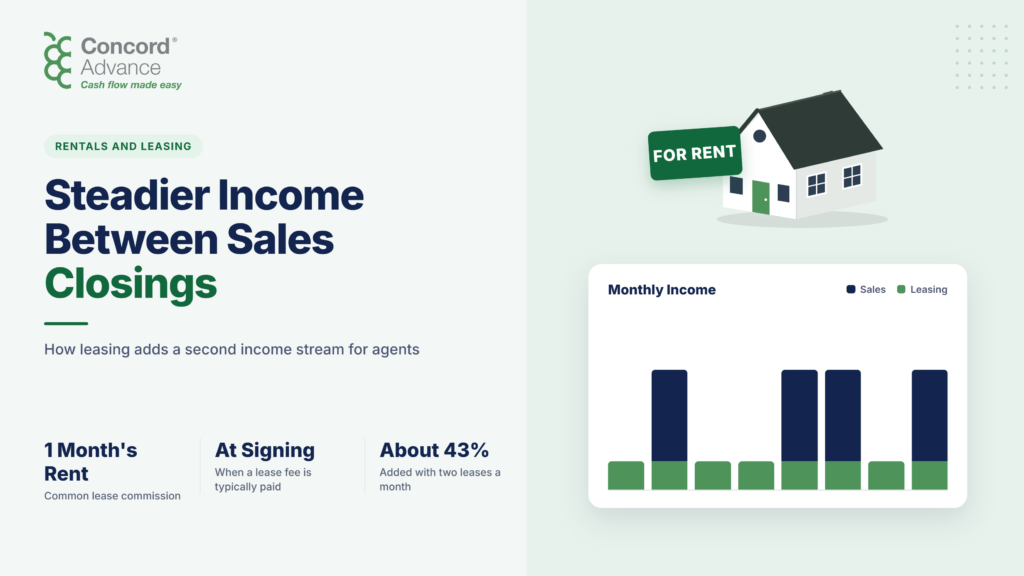
A sales commission arrives at closing, usually weeks or months after the contract is signed. A residential lease commission is typically paid when the lease is signed and the first month’s rent or security deposit is collected, which places it days or weeks after an accepted application.
For agents whose income depends entirely on purchase closings, adding leasing introduces a second revenue stream with a different payment calendar.
The decision involves considering licensing, brokerage policy, trust account rules, local fee customs, and the time each lease requires. This guide covers the economics, the compliance points, and how agents add leasing in a way that fits the business they already run.
Key Takeaways
- Residential leasing commissions are commonly one month’s rent or 10% to 15% of the first year’s rent, and they are typically paid at lease signing and collection of the first month’s rent or deposit.
- A lease commission is smaller than a sales commission, so the effect on annual income depends on volume.
- In most states, leasing property for others for compensation is licensed activity, and agents perform it under their broker.
- Brokerages differ on leasing splits, fees, and property management policy, and E&O coverage can treat leasing differently from sales.
- Property management adds recurring revenue, commonly 8% to 12% of monthly rent plus a leasing fee of 50% to 100% of one month’s rent, along with ongoing operational responsibility.
- In New York City and Massachusetts, the party who hires the broker pays the fee, which places more of the leasing opportunity with the landlord and listing relationships.
How Leasing Income Differs From Sales Income

The absence of financing, appraisal, and title steps shortens the path from agreement to payment. Fee size per transaction is the trade-off, which is why the break-even math matters.
The Break-Even Math
Consider a $450,000 sale at a 2.5% side commission. The gross is $11,250, and at a 70/30 split the agent’s net is $7,875. For a $2,400 monthly rental:
| Lease fee basis | Gross fee | Agent net at 70/30 | Leases to equal one sale |
| One month’s rent | $2,400 | $1,680 | about 4.7 |
| 10% of first-year rent | $2,880 | $2,016 | about 3.9 |
Some brokerages apply a different split or a flat fee to rentals, so the agent’s own agreement sets the real figure.
How splits and fees change what an agent keeps is covered in [The Real Math Behind Splits: What Agents Actually Keep at Different Brokerage Models].
What Leasing Does to the Income Calendar
Sales closings tend to arrive in clusters, with quiet stretches between them. Leases add smaller payments on a more regular schedule. An illustration, using the same $7,875 sale net and $1,680 lease net:
| Income source | Volume | Agent net |
| Sales only | 12 closings | $94,500 |
| Leasing added | 24 leases (two per month) | $40,320 |
| Combined | $134,820 |
Two leases a month adds about $3,360 in monthly agent net, which is roughly 43% on top of the sales-only figure. The leasing deposits also arrive between sales closings, which is where the smoothing effect shows up.
Licensing, Trust Funds, and Brokerage Policy
Licensing. In most states, leasing property for others for compensation is licensed activity, and sales agents do it under their broker. Property management typically adds the handling of rents and security deposits as trust funds, and owning a management firm generally requires a broker license. A minority of states handle this differently, so the state real estate commission is the authority.
Brokerage policy. Some brokerages apply a different split or flat fee to rentals, route leasing through a dedicated team, or limit property management. These terms usually appear in the independent contractor agreement or a separate rental addendum.
Insurance. E&O policies can treat leasing and property management differently from sales. Confirming coverage before the first lease avoids a gap.
Disclosures. Fair housing rules apply to rentals in the same way they apply to sales. Federal lead-based paint disclosure also applies to leases of most housing built before 1978.
Tenant Placement and Property Management
| Activity | Typical compensation | Ongoing work | Licensing and trust funds |
| Tenant placement | One month’s rent or 10% to 15% of first-year rent, per lease | Per transaction | Licensed agent under a broker |
| Property management | 8% to 12% of monthly rent, plus a leasing fee of 50% to 100% of one month’s rent | Rent collection, maintenance coordination, accounting, owner reporting | Broker license in most states, with trust accounts |
At a $2,400 rent and an 8.5% fee, management produces about $204 per unit per month. Across 30 units, that is $73,440 a year in gross fees, before brokerage splits and operating costs. Many agents begin with tenant placement for landlord clients they already know, and some refer management work to an established management company, which can bring a referral fee.
How Fee Rules Differ by Market
Where the fee comes from varies by city and state. Since June 11, 2025, New York City’s FARE Act has required the party who hires a broker to pay that broker. In most NYC rentals the landlord hires the listing broker, so the landlord pays, and a tenant pays a broker fee only after hiring an agent under a written agreement. Massachusetts adopted a similar rule on August 1, 2025.
In those markets, leasing income depends on landlord relationships and on winning listings, and tenant representation remains a fee-paying option under a written agreement. Agents in other markets benefit from checking local custom and any new rules before building a fee model.
Where Leasing Feeds the Sales Business
Leasing builds two pipelines that sales practices often lack. Landlords who place tenants with an agent tend to hold investment property, and they list those properties when they sell. Tenants who work with an agent become buyers when they are ready, and the agent already knows their timeline and budget.
A Practical Way to Add Leasing
- Review the brokerage agreement for the rental split, fees, and any property management restrictions.
- Confirm E&O coverage for leasing activity.
- Begin with tenant placement for investor and landlord contacts already in the database.
- Use the state association’s lease forms and a written screening and fair housing process.
- Track the number of leases, the time each requires, and the net fee for one quarter before deciding whether to add management.
Common Questions
Do real estate agents earn commission on rentals?
Yes. A rental agent typically earns a fee per lease, commonly one month’s rent or 10% to 15% of first-year rent, before the brokerage split.
When is a rental commission paid?
Typically at lease signing and collection of the first month’s rent or security deposit, though brokerage policy and local custom set the exact timing.
Is a separate license required for rentals?
In most states the same real estate license applies, with the agent working under a broker. Managing property and holding rents and deposits generally involves trust account rules and a broker license, and the state commission confirms the specifics.
Does commercial leasing pay differently?
Yes. Commercial leasing commissions are typically calculated on the aggregate rent over the lease term and are often paid in installments between lease execution and rent commencement.
Who pays the rental commission?
It varies by market. In New York City and Massachusetts, the party who hires the broker pays.
The Bottom Line
Leasing adds a second income stream that pays sooner and in smaller amounts, and it brings landlord and tenant relationships that feed the sales business. The benefit depends on the brokerage’s leasing terms, the local fee structure, and enough lease volume to matter.
Agents who confirm those three points before the first lease can add leasing with a clear view of what it will contribute.
Leasing income arrives sooner, and sales commissions still arrive at closing. Agents with pending sales closings can access those commissions early through Concord Advance, at a rate based on time to closing. Full pricing at concordadvance.com/rates-page.

